
This post contains affiliate links. I will earn a small commission, at no extra cost to you, if you make a purchase through these links.
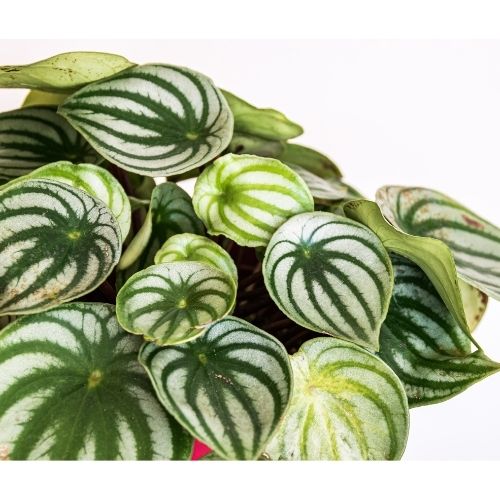
The Watermelon Peperomia (Peperomia argyreia) is an absolutely adorable little peperomia easily recognized for the watermelon-esque pattern on its foliage.
Read on for a full care and propagation guide, plus, other important tips you MUST know when caring for this plant!
Where can I buy a Watermelon Peperomia?
You can easily find a Watermelon Peperomia for sale on Etsy! Check out this gorgeous peperomia from one of my favorite Etsy shops.
Is Watermelon Peperomia easy to care for?
The Watermelon Peperomia is so easy to care for. Peperomias are generally slow growing, so some people might mistake that for being difficult. While this peperomia might not be the fastest grower, it’s a delightfully easy little plant!
That, combined with the fact that it’s so unique and just plain beautiful, makes this a perfect houseplant for almost anyone.
Is Watermelon Peperomia a succulent?
No, Watermelon Peperomia is not categorized as a succulent. However, they do have succulent-like leaves that store some water.
How do I care for my Watermelon Peperomia?
The basic care requirements for this cute little peperomia are:
- Provide with bright to medium, indirect light
- Water when the top two inches of the potting mix is dry
- Plant in a well-draining potting mix
Read on for more important care details!
Light
Give your Watermelon Peperomia bright to medium, indirect light. It’s important to keep the light INDIRECT, as direct light can scorch the adorable little watermelon leaves.
On the other hand, not having enough light can lead to a very sad plant with leggy and sparse growth. And variegated plants like this one can even lose their variegation in low light.
Grow lights are an excellent solution to the lack-of-light problem that plagues so many plant parents, including myself! In fact, these are two of my very favorite sets of grow lights:
They are so convenient for where I need them (clipped onto a shelf, and inside my greenhouse cabinet) and my plants are really happy underneath them. Yay!
Water
Water when the top two inches of your peperomia’s potting mix is dry. You don’t want to have it sitting for a long time in a soaking-wet pot, but you don’t want it to dry out either.
How do you know when the top two inches are dry? You have to feel the potting mix!
Yea, you have to get a little dirty, but it’s a small price to pay to prevent root rot. This is how you’ll know if your plant actually NEEDS water, rather than guessing and overwatering it.
Potting Mix
Watermelon Peperomia is not very high maintenance with its potting mix. It just needs a well-draining mix to keep it from staying too wet.
To accomplish this, you can use a general indoor plant potting mix with some additional perlite added in. I always just eyeball the perlite—usually a few handfuls depending on the size of the pot!
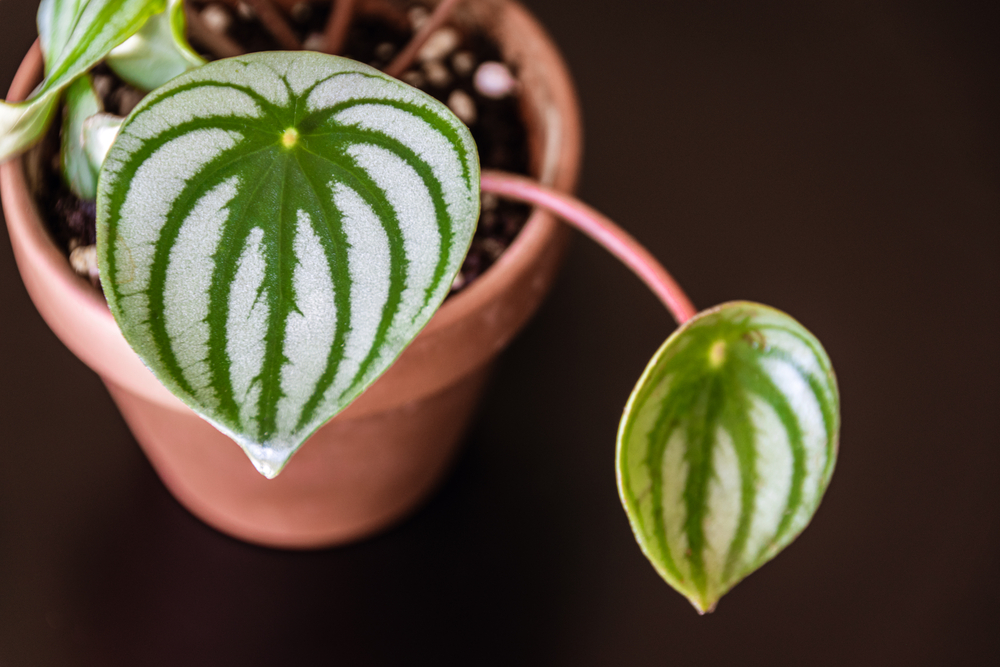
How gorgeous is this peperomia? Click here to buy one!
Repotting
Watermelon Peperomia doesn’t need to be repotted often—they are slow growing and like to get a little root bound!
Repot every two to three years. When you see roots coming out of the drainage holes, that’s a good sign that it’s time to repot.
Use a pot the next size up from its current pot, and make sure it has a drainage hole. Try to repot only during the growing season (the spring and summer).
Fertilizing
Use a houseplant fertilizer at half-strength, once a month during the growing season (spring and summer). A little bit of fertilizer is good, but you never want to overdo it with peperomias.
Humidity
Native to South America, this peperomia will definitely appreciate extra humidity! There are a few different methods to provide humidity to houseplants. My favorite method is to use a humidifier.
It’s easy, low maintenance, and lasts longer so it’s less for me to worry about (yay!). The humidifier below is one of my favorites because it can last for up to 96 hours.
Temperature
Coming from the tropical climates of South America, this peperomia prefers warmer temperatures—between 65 and 80 degrees Fahrenheit (about 18 to 27 degrees Celsius).
However, you don’t need to stress about the EXACT temperature. Just try not to let your peperomia get too cold. You might need to remove it from windowsills or other cold areas in the wintertime.
Pruning
Pruning this peperomia is generally not necessary except to gently remove any dead or dying leaves.
Foliage and Flowering
The Watermelon Peperomia has round leaves that are pointed at the tip with a light-green and dark-green watermelon-esque pattern. The leaves grow at the end of a reddish-brown petiole.
This peperomia blooms occasionally, but they don’t look anything like your “typical” flower. They look like green spikes at the end of the reddish-brown stems.
In fact, the very first time my Peperomia Obtusifolia flowered I had no idea what the flowers looked like. My initial reaction was basically, “Wtf is that on my plant?”
If your plant has many flower spikes, consider cutting them off so they don’t drain energy that could be going towards the watermelon foliage.

Cleaning the leaves
Since this adorable little Peperomia has nice, wide, round leaves, it’s great at collecting dust! Removing any dust and grime from the leaves will help your plant photosynthesize better and stay bright and beautiful.
This is not something you need to worry about doing religiously, though.
When you notice some build-up on the leaves, use a cloth to gently wipe the leaves clean, making sure to support the undersides of the delicate little watermelon leaves. You can dampen the cloth if you need to.
Watermelon Peperomia Propagation
Propagation Using Leaves
One thing that makes peperomias so special is that they can be propagated using only their leaves!
- Remove a few healthy leaves from your peperomia. You don’t need the petiole for this method—just the leaf.
- Use a pair of clean, sharp scissors to cut horiztonally, right across the center of each leaf.
- Plant the leaves, cut side down, into moist potting medium—potting mix, sphagnum moss, or another medium you prefer to use for propagation.
- Place that in bright, indirect light and in a humid area.
- You can easily give your leaf cuttings extra humidity by placing a clear plastic bag or lid over the top. Remove it once in a while so it doesn’t get too muggy inside.
- Keep your potting medium lightly moist as the new roots develop.
- Remember, peperomias are slow growers, so have patience! Eventually, you’ll notice new roots and some teeny, tiny baby plants sprouting.
- When your baby plant(s) is around a few inches tall, remove it from the old cut leaf and plant it into its permanent pot.
Propagation Using Petiole Cuttings
You can also propagate Watermelon Peperomia with petiole cuttings.
- Cut off a few healthy stems. Then, cut the stem back so only about a half-inch of the petiole is still attached to the leaf.
- Stick the petiole into moist potting medium—potting mix, sphagnum moss, or another medium you prefer to use for propagation.
- The leaf should be above the potting medium—not buried.
- Place that in bright, indirect light and in a humid area.
- You can easily provide extra humidity by placing a clear plastic bag or lid over the top. Remove it once in a while so it doesn’t get too muggy inside.
- Keep your potting medium lightly moist as the new roots develop.
- Once again, you’ll need to have some patience because peperomias are slow growers.
- Once roots have developed you can start treating the cutting like a normal plant.
- To check if roots have developed, after the first few weeks you can very gently tug the cutting and feel if you’re met with any resistance.
Watermelon Peperomia Problems
Below are some common Watermelon Peperomia along with common causes.
- Drooping leaves – This is often due to your plant being too dry
- Curling leaves – This is also often due to your plant being too dry
- Yellow leaves – This is often caused by overwatering
- Leaf drop – This is also often caused by overwatering
- Root rot – This is caused by consistent overwatering. When your plant is constantly soaking wet, it drowns the roots and kills the plant. The is the easiest way to kill a plant. For more help, see my post about saving your plant from root rot!
- Pests – Some possible pests for Watermelon Peperomia include mealybugs, scale, spider mites, whiteflies, and fungus gnats. For general pest prevention and control, I really like Bonide Systemic Houseplant Insect Control. I use it on any new plant I bring into my home.
Additional Information
Growth Rate and Size
The Watermelon Peperomia is a slow-growing plant. Ugh, such a bummer, right? Regardless, don’t let their growth rate discourage you from owning one of these adorable little peps!
This peperomia can grow from 6 to 12 inches tall in optimal conditions.
Is Watermelon Peperomia toxic to humans?
The Watermelon Peperomia is non-toxic to humans…but please don’t try to eat it! Even if it’s not deadly, it can still cause stomach trouble.
Is Watermelon Peperomia toxic to cats?
The Watermelon Peperomia is non-toxic to cats and dogs. However, please remember that even non-toxic plants can cause a pet to have tummy troubles.
Click here to buy a beautiful Watermelon Peperomia!
Watermelon Peperomia Care Summary
- Provide with bright to medium, indirect light
- Water when the top two inches of the potting mix is dry
- Plant in a well-draining potting mix
- Repot every two to three years when you see roots coming out of the drainage holes
- Use a houseplant fertilizer at half-strength, once a month during the growing season
- Provide with humidity and warm temperatures
- Gently remove any dead or dying leaves
- Occasionally use a cloth (dampened, if needed) to gently wipe the leaves clean, supporting the undersides of the leaves while you do so
More Peperomia Posts
- Peperomia Verticillata (Red Log)
- Peperomia Raindrop
- Cupid Peperomia
- Peperomia Frost
- Peperomia Hope
- Peperomia Prostrata (String of Turtles)
- Peperomia Obtusifolia
Leave a Reply