
This post contains affiliate links. I will earn a small commission, at no extra cost to you, if you make a purchase through these links.
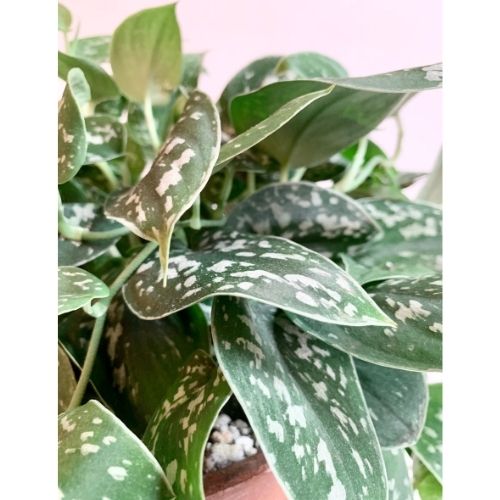
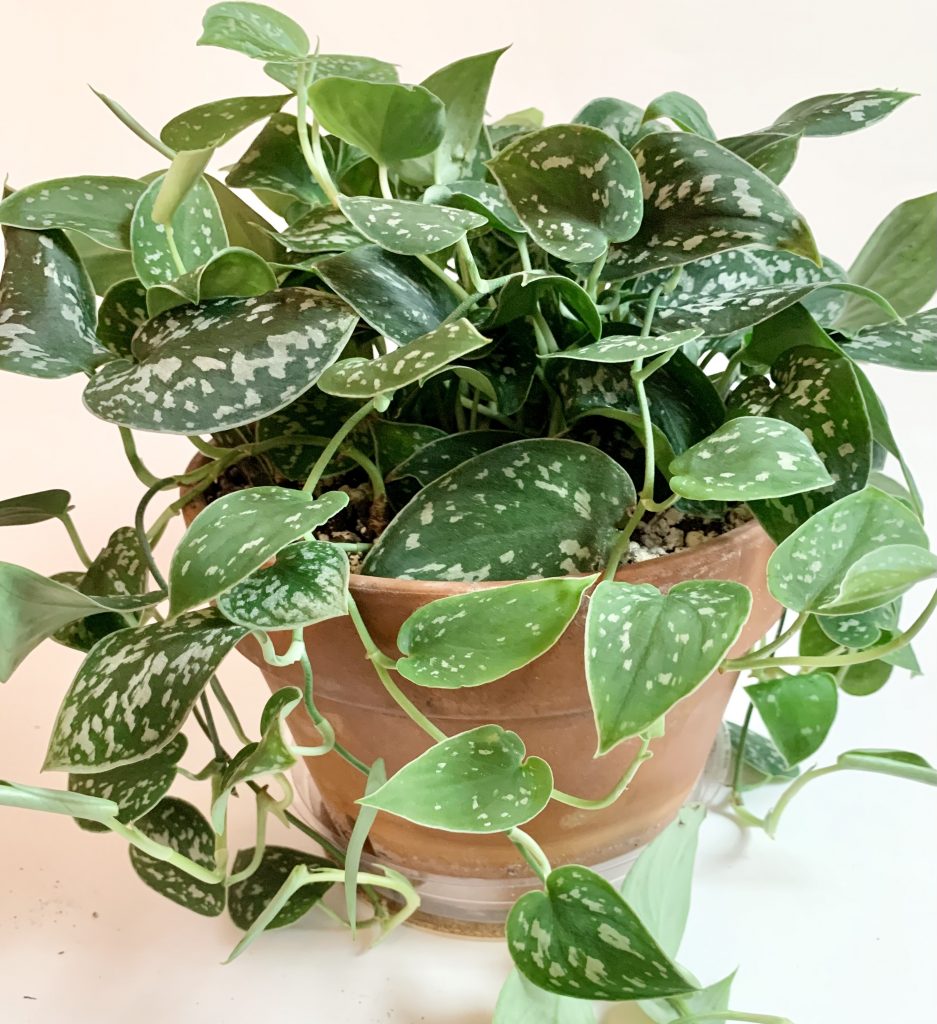
Satin pothos is a beautiful climbing plant known for its shimmery leaves of green and speckled-silver variegation. In this post, I’ll go over everything you need to know about satin pothos care and propagation, and I’ll also answer some other common questions.
Satin pothos is a variety of Scindapsus pictus. Specifically, it is Scindapsus pictus ‘Argyraeus.’ It’s also sometimes referred to as a silver philodendron. But guess what—it’s not technically a pothos OR a philodendron.
Their care requirements are all very similar and they look similar, too, but Scindapsus pictus, pothos, and philodendron are all under their own genus: Scindapsus, Epipremnum, and Philodendron. So, even though it is not actually a pothos, I’ll be referring to this plant as “satin pothos” because that’s its common name.
Where can I find a satin pothos?
You can easily find a satin pothos on Etsy! At the time I’m writing this post, we’re just coming into spring and it’s the perfect time to start buying plants again (yay!).
Check out this gorgeous satin pothos from one of my favorite Etsy sellers.
Satin Pothos Care
How much light does a satin pothos need?
Bright to medium, indirect light is best. Do not put your plant in direct light or it will scorch the leaves.
Satin pothos can tolerate low light, but note that it is typical for variegated plants to lose variegation in low light. My satin pothos doesn’t receive a lot of light on one side and I’ve actually only noticed a small amount of variegation loss, but just keep it in mind if you decide to put yours in low light.
If you don’t have enough light for your satin pothos, you can use grow lights. In fact, my satin pothos is thriving under its grow lights! The main grow light I use is the first one below. The second grow light below is in my greenhouse cabinet, which my plant is right next to, therefore, it receives a little bit of light from that, too.
(If you won’t be using grow lights, check out my post on natural light for indoor plants for more help.)
How often should you water a satin pothos?
Water your satin pothos when the top inch or so of the soil is dry. You’ll also notice leaves starting to get a bit curly and droopy, which usually means it’s too dry.
Be careful not to overwater it or you could put your plant at risk of root rot. Always stick a finger into the soil before watering to determine moisture level.
Do satin pothos like humidity?
Satin pothos prefers higher humidity, as it is native to tropical areas of Asia. (However, they are very low-maintenance plants and pretty tolerant of normal household humidity.) There are a few easy ways to provide humidity to houseplants, with the easiest being using a humidifier.
My post on how to create humidity for houseplants has more methods with step-by-step instructions.
Potting Mix
One of the easiest parts of satin pothos care is that it doesn’t need a specialty potting mix, just a well-draining indoor plant mix. I always add a few handfuls of perlite if I have it on hand for extra drainage.
Fertilizing
This plant doesn’t need a lot of fertilizer to thrive. In fact, mine has been thriving for the past few months since I’ve had it (and it’s WINTER). That said, fertilizing occasionally is helpful.
You can use a balanced liquid houseplant fertilizer once a month during the growing season (spring and summer).
Repotting
While satin pothos is low-maintenance, it IS a fast grower, so you might have to repot it every year. If it’s still thriving in its current pot, then don’t worry about it. But if it’s getting too big for its pot, or is looking a little sad with some stunted growth, it might be rootbound.
You can confirm if your plant is rootbound by checking if the roots are coming out of the drainage holes or by turning it on its side and gently slipping it out of the pot. See if the roots are all in a heavy coil around the outside of the soil. If so, it is rootbound, and time to repot!
If possible, try to repot in the growing season (spring and summer). Use a pot the next size up from its current pot that has good drainage.
Climbing and Support
Satin pothos naturally climbs up trees in the wild using aerial roots. Putting those aerial roots to use and giving your plant something to climb, like a moss pole, will help your plant grow big and strong. Here is a stackable moss pole I recently purchased for another climbing plant.
Mist your moss pole as part of your watering routine so that the aerials roots can get some water, too.
Pruning
Although it’s not required, you can prune your satin pothos to control its size and shape. For example, you might want to keep it compact and full or trim off any long, leggy vines. Legginess is when a vine or stem grows very long with fewer leaves. It is usually due to the plant trying to grow toward more light.
To prune your plant, use a pair of clean, sharp scissors to cut above a node. This will encourage the plant to put out new growth. (The node is where leaves and roots grow out of the stem. Cutting above a node means the node is NOT included on the part you cut off.)
In addition to this, remove any dead or dying leaves once they can be plucked away gently. A yellow leaf here and there is normal and not something to worry about.
Problems and Pests
Plant problems can be caused by a number of things, so it’s important to do an overall evaluation of your satin pothos care routine. However, below are the most common reasons for a few common problems you might experience.
Why are the leaves on my satin pothos curling?
Curling or droopy leaves on your satin pothos typically means your plant is in need of water. It should perk back up after a thorough watering.
Yellow leaves
The most common cause of yellow leaves on satin pothos is overwatering. One or two yellow leaves after watering is not something to worry about, but if your plant has many yellow leaves you should evaluate how often you’re watering your plant.
Brown, crispy leaves
The most common causes for brown leaves are too much direct light or too little water. Move your plant out of direct light and use your fingers to feel if the soil is very dry.
Pests
Satin pothos is relatively resistant to pests, but some potential pests include spider mites and scale.
There are more in-depth ways to get rid of these particular pests if you are really struggling, but for general pest control, I like using Bonide Systemic House Plant Insect Control. I find it to be an easy solution for light infestations and I sometimes use it as a preventative measure, too.
Always read the instructions on the label first and use caution if you have kids or pets.
Satin Pothos Propagation
Satin pothos propagation is very easy. Here are a few methods:
Satin pothos propagation in water
Take a pair of clean scissors and cut below a node on a vine that has a few healthy leaves. If possible, take a few cuttings to increase your success rate.
The node is where the leaves and roots grow out of the stem, and cutting below a node means the node will be included on the part you cut off. Your new roots are going to grow out of the node.
Put the cutting in a jar of room-temperature water. Make sure at least one node, but no leaves, are under the surface. Put the jar in bright, indirect light. Refill the water as needed and replace it once a week or so when it looks grimy.
Once the roots are around three inches long, which will take at least a few weeks, you can plant your cutting into a more permanent pot with potting mix. Then, give it a good watering and care for the plant how you normally would.
You can also keep the cuttings in water permanently, but they will not grow as fast or as large.
I’m actually propagating some satin pothos cuttings as I write this post. Here is the propagation station I’m using in the photo below (it comes with mounting supplies if you want to hang it on the wall, too).

Satin pothos propagation in potting mix
Method One
This follows the same general process as water propagation.
Take a pair of clean scissors and cut below a node on a vine that has a few healthy leaves. If possible, take a few cuttings to increase your success rate.
The node is where the leaves and roots grow out of the stem, and cutting below a node means the node will be included on the part you cut off. Your new roots are going to grow out of the node.
Plant the cutting into a small pot with moistened potting mix. Make sure at least one node, but no leaves, are buried. Put the pot in bright, indirect light. Keep the potting mix moist, but not wet, as the roots develop.
You can also put a clear plastic bag over the top of the pot to help lock in beneficial humidity. Just remove it every other day or so to let in fresh air.
After about a month, you can test your cuttings’ progress by giving the stems a gentle tug. If you feel resistance, that means a root system has developed and you can now start treating your cuttings like a normal plant.
Method Two
This is another simple method.
Take a pair of clean scissors and cut off a vine that has a few healthy leaves. If possible, take a few cuttings to increase your success rate. You don’t have to worry about cutting below a node in this method because you’ll actually be using all the nodes that are growing along your cutting.
Lay the entire cutting on top of a pot with moistened potting mix, making sure the nodes are facing down into the mix while not burying any leaves. If you need to, you can temporarily fasten the stem to the potting mix using bobby pins or paper clips.
Put the pot in bright, indirect light. Keep the potting mix moist, but not wet, as the roots develop. You can also put a clear plastic bag over the top of the pot to help lock in beneficial humidity. Just remove it every other day or so to let in fresh air.
Roots will eventually sprout from each node that is in contact with the potting mix.
After about a month, you can test the cutting’s progress by giving it a gentle tug. If you feel resistance, that means a root system has developed and you can now start treating it like a normal plant.
Additional Information
Other Scindapsus pictus varieietes
There are four common and similar varieties of Scindapsus pictus that are often confused for each other. I actually had a difficult time finding a clear explanation of the different varieties and this website helped me out a lot so I have to give credit where credit is due!
- Scindapsus pictus ‘Argyraeus’ (The one discussed in this post)
- Scindapsus pictus ‘Exotica’
- Scindapsus pictus ‘Silver Satin’
- Scindapsus pictus ‘Silvery Ann’
They are all very beautiful with similar care requirements, but they look slightly different.
Growth Rate and Size
Satin pothos is a fast grower. In optimal growing conditions, it can grow several feet in one year.
How do you make satin pothos grow faster?
Satin pothos is already a fast grower, but you can ensure it grows as fast as possible by providing it with:
- Bright, indirect light
- Proper watering – When the top inch or so of the potting mix is dry
- Fertilizer once a month during the growing season – Just be careful not to overdo it
- Proper temperature – This basically means don’t put it on a cold windowsill in the winter. It should stay between 65-85 degrees Fahrenheit, so normal household temperatures are typically fine
Is satin pothos toxic to cats and dogs?
Yes, satin pothos is toxic, so be sure to keep this plant out of your furry friends’ reach.
More pothos posts
Big pothos fan? Me too! Check out my care and propagation guides for these other pothos varieties:
- Shangri La Pothos
- Manjula Pothos
- Marble Queen Pothos
- N’Joy Pothos
- Neon Pothos
- Cebu Blue Pothos
- Golden Pothos
- 13 Pothos Varieties That You Can Easily Care For
Cj Hoekstra says
Hi there! Under the water propagation method you mention the black on the roots. I just noticed mine have this too that have been in water for about 4 weeks. I was wondering if you ever found out what caused it? Or if it was root rot and my cuttings are gonners ?
Julie - Houseplant Aficionado says
Hi CJ – I’m still not sure exactly what it is but it definitely was not rot. My cuttings were totally fine and I recently potted them up and they are still growing. If I ever find out I’ll update this post! Just be sure to change your water regularly just in case.
Mo says
Hi Julie- I am propagating a satin pothos cutting in water and the root that emerged was white at first but now it’s black like the center picture you have of your cuttings propagating in water! Is your cutting doing ok? I’m worried it’s dying but it looks more like black fuzz actually growing from the root than rot. I’d appreciate any updates about your cutting so I can hopefully have peace of mind about mine! It took my cutting more than a month to start rooting so I’m very attached to it already. Thanks in advance!
Julie - Houseplant Aficionado says
Hi Mo – I actually JUST answered another similar question. See my response to CJ’s comment. Looks like it might be a common issue but I don’t think you need to worry 🙂
Amanda says
Hi. When you say to cut above or below the node, does that mean when the vine is hanging down or lifted up? In videos, I’ve seen people lift it up so that the end of the vine is facing the ceiling, and sometimes they leave it hanging down. Of course, they never zoom in so that you can see exactly where they cut. Any pics I’ve found online that do show the cut clearly don’t show the entire vine, so I can’t tell which way is up or down. Above and below are relative to which way the vine is (lifted towards the sky, or hanging down), and I am so confused. Thank you.
Julie - Houseplant Aficionado says
Hi Amanda – I understand this is totally confusing and used to confuse me a lot too! That’s why I always make sure to mention the following in my posts: Cutting below a node means the node will be included on the part you cut off. Cutting above a node means the node will stay on the main plant and is not including on the cutting.
When you see “above” vs. “below,” you can think of the vine as being lifted toward the ceiling.
Briburst says
Thank you for the post! I just inherited a silver pothos from a curbside free pile. It came potted, and has one three inch vine with one very healthy leaf. Near the bottom of the leaf stem are three nodes. It seems to be doing fine, but I want to encourage more leaf growth. I have had it for about a week, so I’m not sure if it will grow new leaves if I leave it. Do you think I should let it be?
Julie - Houseplant Aficionado says
Hi Briburst – Thanks for reading! If it only has one three-inch-long vine I would let it grow a little more. That’s pretty small. Once the vine is a little longer you can prune it to encourage new growth and propagate the cutting.
SG says
Hi Julie, I recently propagated a Silver Anne in potting soil mix (laying them in the mix). Within a week, I got some roots (half inch long). When should I pot them? Should I still wait for another few weeks?
Julie - Houseplant Aficionado says
Hi SG – If you want to transfer them to another pot instead of leaving them there, yes, I would wait a few more weeks until the roots are around two to three inches long.
Prashanti says
Hi, I bought a silver satin pothos from online store in 3inch pot. It didn’t grow as it’s roots got damaged, so I put the plant in water as recommended. I could see the leaves turning dry and a part of stem getting darker in color. Would it survive or should I purchase another cutting ?
Eddie says
Hi –
I have several satin pothos cuttings that I’ve rooted in water. I am going to transfer them into potting soil. Since it is a fast grower, can I plant them in a large pot instead of a small one?
Thanks
Julie - Houseplant Aficionado says
Hi Eddie – Using too large of a pot could lead to overwatering, so I would not use a pot too much larger than one they would normally fit in.
Betsy says
Any update on the black root? Mine keep turning black no matter what I do