
This post contains affiliate links. I will earn a small commission, at no extra cost to you, if you make a purchase through these links.
Something that many plant owners struggle with is light for their indoor plants. Figuring out your houseplants’ light requirements, understanding what that actually means, and then trying to find the perfect spot in your home that has that kind of light—it gets tricky. In this post, I’ll break down different aspects of natural light for indoor plants so you can figure out where your houseplants are most likely to be happy.
I want to address houseplants and low light first because it’s something a lot of plant owners are concerned about. Understandably so! It’s much easier to block out too much light than it is to add more light.
Can houseplants survive without natural light?
Sure, many houseplants can survive without natural light and only artificial light. Keep in mind, it’s ideal if artificial light is a supplement to natural light, not a total replacement. However, if you have virtually zero natural light, then go for grow lights!
(Check out my post on the best grow lights for indoor plants and other grow light questions answered.)
I live in a low-light home and I know it can be frustrating. I have north- and south-facing windows, except any sun coming from the south is almost completely blocked by trees. (Note: We’ll discuss window orientations further in-depth below.)
If you’re in a similar situation it’s totally fine to stick with low-light houseplants, but I got tired of these limitations and eventually decided to purchase some grow lights to supplement the light in my home. These are the ones I chose and I am loving them so far! Check them out in the photo below.
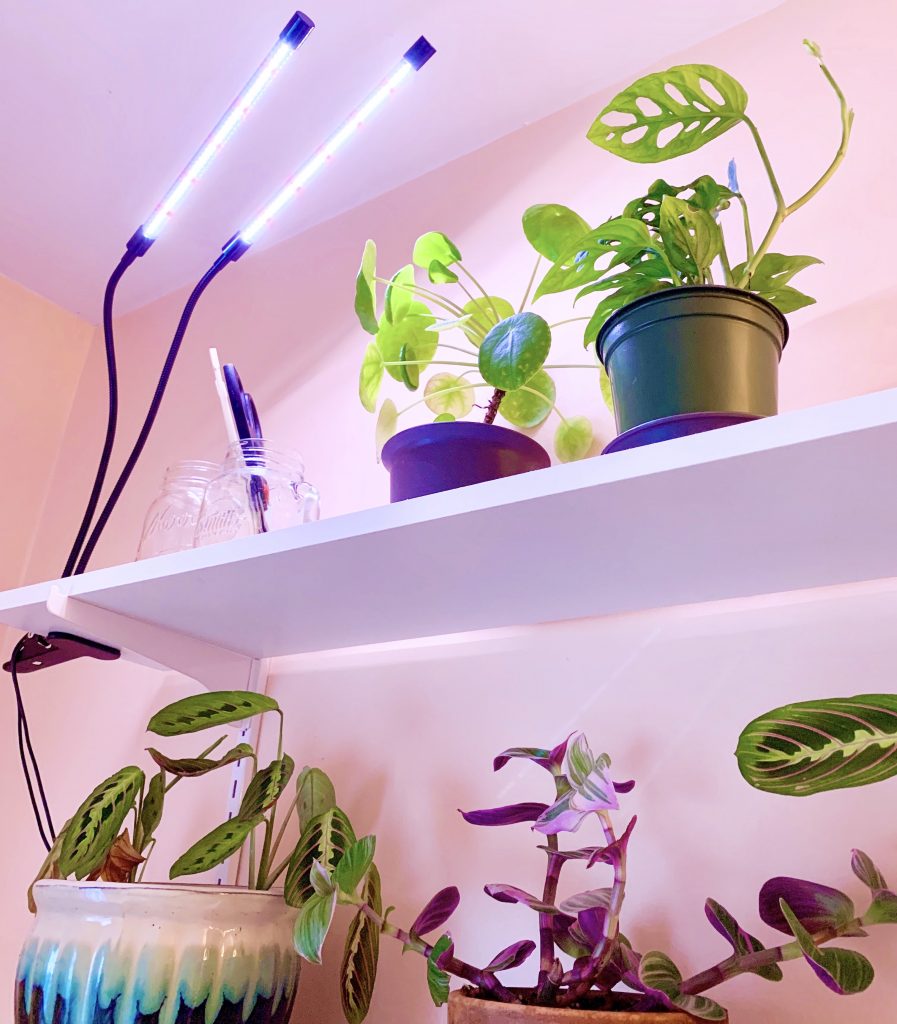
Update: I purchased more grow lights a few weeks ago that have also been working out really well, so including the ones I described above, here are the two grow light sets that have really come in handy in my space:
Which plants can survive without sunlight?
I’d suggest considering a grow light if you have a complete lack of natural light, but if this isn’t an option for you, some houseplants that will survive—and keep in mind, survive is different than thrive—in low light include:
- Snake Plant – Get yourself a snake plant here!
- Chinese Evergreen – Get yourself a Chinese evergreen here!
- ZZ Plant – Get yourself a ZZ plant here!
- Dumb Cane – Get yourself a dumb cane here!
- Parlor Palm – Get yourself a parlor palm here!
- Cast Iron Plant – Get yourself a cast iron plant here!
- Maranta – Get yourself a maranta here!
- Philodendron – Get yourself a philodendron here!
- Calathea – Get yourself a calathea here!
- Arrowhead Plant – Get yourself an arrowhead plant here!
Now that we’ve addressed some common questions about low light, let’s move onto the basics of natural light for indoor plants.
Types of Light
Direct Light
Direct light means there is a direct path from the sun to your plant. The sun’s rays will be hitting the plant directly. If you think of a plant as a human, a plant sitting in direct sun would need sunglasses and would be getting sunburnt. Actually, plants CAN get sunburnt. Too much of anything is generally not good, and houseplants do not like to sit in too much direct sun. This is even true for succulents!
Indirect Light
In indirect light, there is NOT a direct path from the sun to your plant. Indirect light reflects off another surface before hitting your plant.
Filtered Light
Filtered light is sometimes categorized as indirect light but sometimes used as its own term. Typically, filtered light is when a sheer curtain or something similar is blocking direct light. With outdoor plants, this usually means trees are filtering out some sunlight.
Light Levels
Bright Light
Bright light typically means direct light. There is nothing between the light and your plants. This is why it’s important that bright, indirect light is specified. As we know from the section above, there is a big difference between direct and indirect light.
Medium Light
Medium light typically means indirect or filtered light. There might be a sheer curtain in front of the window or your plant could be a few feet away from a bright-light window, so it still wouldn’t be in the direct path of the sun’s rays.
It might not seem like there’s much of a difference between medium light and bright, indirect light. They are similar. Just think of bright, indirect light as being slightly—for lack of a better word—brighter.
Low Light
Low light typically means very far away from the light source, receiving almost no natural light. It could also mean in front of a window that is significantly blocked by trees or another building, or no natural light at all but fluorescent light instead. These are the plants you find in the middle of malls and wonder how the heck they’re surviving.
Keep in mind, low light is not total darkness. You should still be able to read a book in low light. (I’m not sure if she came up with that analogy but Planterina was the one who first ingrained that into my brain.)

Note that most houseplants do better with more light. I don’t mean super bright, direct light, I just mean more light. There aren’t a lot of plants that LOVE being in low-light conditions. Rather, they just tolerate it better than others. Even everyone’s favorite low-light plant, the snake plant, prefers medium light.
As you think about these different levels of light for indoor plants, keep in mind a common saying amongst the indoor/outdoor plant community: The shadiest spot outdoors still gets more light than the brightest part of your home. Weird to think about right? But outside, plants receive natural light from all angles whereas the only source of natural light for indoor plants might be a window or two.
Window Orientation (The Direction Your Window Faces)
First, I’d like to note that I am writing this from the northern hemisphere. If you’re in the southern hemisphere, my explanations of north-facing windows and south-facing windows will be reversed. East-facing windows and west-facing windows do not change.
North-Facing Windows
North-facing windows receive the least amount of sunlight. Consider sticking your low-light plants here, but just remember in the winter things might get a little TOO dark in your north-facing rooms. Also, with the lack of sunlight, they tend to be the coldest rooms.
South-Facing Windows
Just as the sun is weakest in north-facing windows, the sun is strongest and remains the longest in south-facing windows. This is because the sun follows an arc across the southern sky as it moves from east to west throughout the day. Stick your full-sun-loving plants here!
East-Facing Windows
The sun rises in the east and sets in the west, so east-facing windows will receive early moderate-to-bright sunlight which will be gone by the afternoon. East-facing windows can be considered somewhat of a happy medium for plants. Plants that like medium light will do well here, and lots of bright- or low-light plants can adjust to medium light.
West-Facing Windows
Being the opposite of east, west-facing windows will receive bright light in the afternoon hours up until the sun sets. West-facing windows are also a good choice for plants that like a lot of light. However, something to note here is that western rooms can get pretty toasty, especially in the summer.
Keep in mind it’s possible that your windows are not facing in these EXACT directions. Perhaps your windows are oriented to the north-east, south-west, etc. Luckily, there are many compass phone apps you can use to easily figure out your situation and then position your indoor plants accordingly!
Ali says
I need to know what that plant is called that you have in your north facing window that you show in this article!
Julie - Houseplant Aficionado says
Hi Ali! I think you’re talking about my Peperomia Obtusifolia. It’s pretty, right? I have a care and propagation guide here: https://sproutsandstems.com/care-for-and-propagate-peperomia-obtusifolia/ 🙂
Alecia Stone says
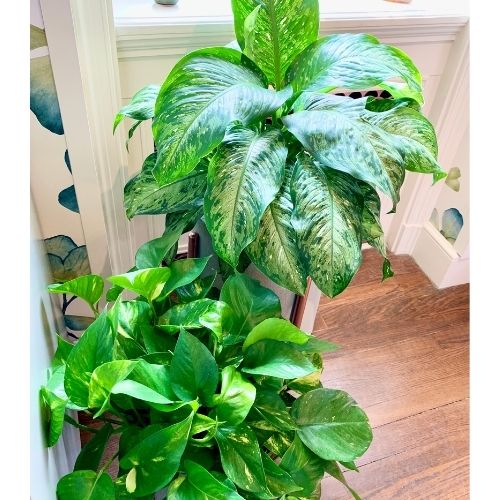
hi what is the name of your plant in your south facing window? thank you.
Julie - Houseplant Aficionado says
Hi Alecia – It’s an Aglaonema Silver Bay (Chinese Evergreen) 🙂
Miranda says
Hi. I have 2 rooms with no windows that I have plants and grow lights in. How close do you recommend the light to be if theyre grow bulbs in a regular light. And what time length for leaving them on? I have a hard time figuring out length of time for light for plants.
Mariace says
Hi, I just got a ZZ raven plant and I love it!! It’s facing a west side small window, would I have to move it? Will it be getting too much light? I don’t want the dark leaves to turn green, I love the dark tones. Thanks!!!
Labijo says
Thank you so much for the light guidance, it help me setup my indoor plants