
This post contains affiliate links. I will earn a small commission, at no extra cost to you, if you make a purchase through these links.
Humidity is an important part of care for many houseplants. This is because a lot of houseplant species are native rainforests and other tropical regions and therefore would be receiving a very high level of humidity in their natural habitats.
Humidity is helpful throughout the year, but depending on the climate where you live, it is especially important in the winter when the air turns dry as a bone and during the summer in homes that heavily use air conditioning.
How do I increase humidity for indoor plants?
There are several easy methods you can use to increase humidity for indoor plants, including a humidifier, a pebble tray, a greenhouse, grouping your plants together, putting your plants in the bathroom, and misting your plants.
I’ll review instructions for each method (and which methods are my favorite and least favorite) below.
Houseplant Humidity Supplies List
Before we dive in, here is a quick list of all the supplies I’ll mention in this post.
- Plant tray
- Larger humidity tray
- Pebbles
- Fish tank
- Air Innovations Humidifier
- URPOWER Essential Oil Diffuser
- Small, portable greenhouse
- Wooden frame small greenhouse
- Plant mister
Methods to increase humidity for indoor plants
Turn On a Humidifier
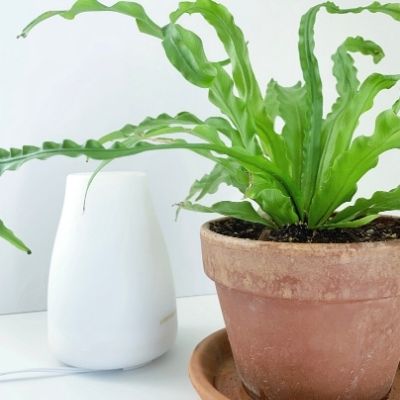
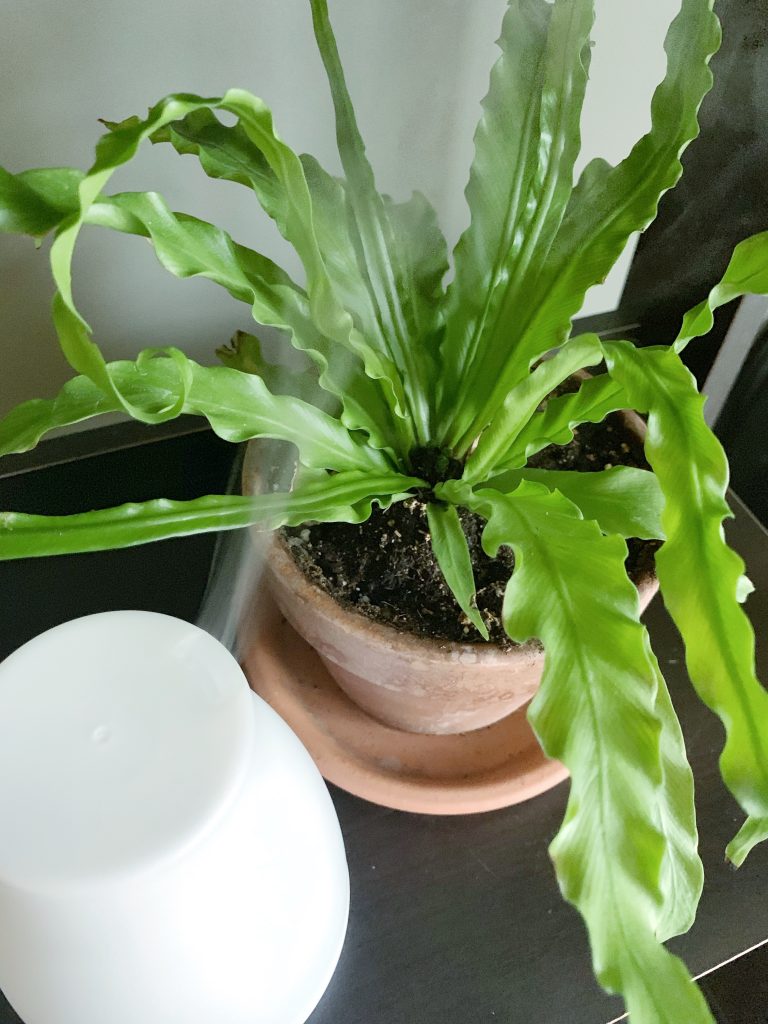
Using a humidifier to increase humidity for your indoor plants is my favorite method because it’s easy and longer lasting. You can use any size humidifier, but if you have a large room with many plants, you’ll want to go for something larger and vice versa.
Below are two of my favorite humidifers:
- Air Innovations Humidifier -This one works great in larger spaces (like if you’re lucky enough to have a dedicated plant room!). It also lasts up to 96 hours!
- URPOWER Essential Oil Diffuser – I’ve had this one for years, and yes, it’s an essential oil diffuser! It works just as well as a small-space humidifier. I like it because it fits well on a shelf or a table and lasts over six hours.
Can you use an essential oil diffuser as a humidifier for plants?
Yes, in fact, you’ll find many essential oil diffusers are also labeled as humidifiers. However, you’ll have to use it in a small space or very close to your plant in order for it to provide humidity.
Make a Pebble Tray
A pebble tray is an easy hack to create humidity that lasts all day long. The concept is simple: A tray filled with water underneath your plant means the water will evaporate all around your plant, creating humidity.
I wouldn’t say this is THE MOST effective method as some humidity dissipates around your plant, but I have used this method and have found it to help.
It can be made even more effective by putting your pebble tray and plant in something that has sides, like a fish tank.
Pebble Tray Materials
- Any typical plant tray will do as long as it’s big enough. It has to be wider than the size of the pot so that the water evaporates around your plant.
- I also really like this larger humidity tray. It has enough room for a few different plants which is really convenient! Consider a larger tray if you have a lot of plants with humidity needs.
- Last but not least, you’ll need pebbles.
- Optional: A fish tank or similar container. It will help keep the humidity more contained around the plant.
Instructions
Lay the pebbles down evenly in the tray. They will act as the surface that your plant sits on. Fill the tray with a little bit of water, but no higher than the pebbles.
Put your plant on top of the pebbles and make sure it’s not sitting below the water’s surface. If it is, remove some water. You don’t want the soil and roots to inadvertently suck up the water! As the water evaporates, it will create humidity around your plant.
Use a Greenhouse
It’s OK if you don’t have one of these in your backyard, most of us don’t! You can find smaller, portable greenhouses, create a terrarium (essentially a mini greenhouse), or even build a greenhouse cabinet.
Portable Greenhouses
This small, portable greenhouse comes in a few sizes and is a great solution if you don’t have the space to commit to a permanent greenhouse.
If you’re in need of something larger, this wooden frame small greenhouse is a little more attractive and would look lovely in a plant corner or on a patio.
Closed Terrarium (Small Greenhouse)
If you have a single plant or a few small plants that need more humidity, consider putting it in a closed terrarium (tutorial here)—a mini greenhouse!
Closed terrariums are their own mini ecosystems and lock in a lot of moisture. The terrarium must be closed to trap moisture. You won’t get this same effect with an open terrarium.
Plastic Bag Over Your Plant (Even Smaller Greenhouse)
You can create your own tiny “greenhouse” for small plants, cuttings, and seedlings by taking a clear plastic bag and putting it over the top to lock in humidity.
Spritz inside the plastic bag to add in even more moisture. Don’t leave this closed 24/7, open it up every other day or so to let in fresh air.
Ikea Greenhouse Cabinet
The humidity in my greenhouse cabinet is almost always above 90%, and my plants LOVE it in there. Check out this post for an easy tutorial on my Ikea Greenhouse Cabinet.
Group Your Plants Together

This method requires no extra materials. Move your plants closer together and they will all benefit from the moisture they are each releasing. Just be sure you’re not spreading any pests or diseases that may be lurking.
Put Your Plants in the Bathroom
If you have windows in the bathroom, keep your high-humidity plants there so that they get a nice dose of moisture every time you shower.
If your bathroom doesn’t have any windows you can still move your plants there temporarily while the shower is on.
Does misting plants help with humidity?
Whether or not misting plants helps with humidity is highly debated. Misting the soil and leaves can help to create a moist environment.
However, some plants don’t like getting their foliage wet, and leaving a plant sitting in constantly wet conditions could lead to pests or rot.
Personally, this is my least favorite method, but you can experiment if misting will work for your plant by misting it every few days for a period of time and seeing how it reacts.
You can mist your plant using a spray bottle or a plant mister. If you use a spray bottle, make sure it actually sprays a mist rather than just producing a single stream of water as some do.
Here is a plant mister very similar to the one I have. It looks great on a shelf, too!
Humidity aside, misting is definitely handy as an alternative watering method for small air plants and also keeping soil moisture high for cuttings or seedlings. I use my plant mister all the time when propagating cuttings.
Common Houseplants that Like Humidity
Here is a list of some common houseplants you might already have in your home that like humidity. This is by no means an exhaustive list.
- Ferns
- Peace lilies
- Pothos
- Air plants
- Spider plants
- Calatheas
- Monsteras
- Peperomias
- Philodendrons
- Lucky bamboo
- Ivy
- Orchid
- Prayer plants
- Alocasias
- Fiddle leaf figs
Houseplants that DON’T like humidity are those that prefer dry conditions, like most succulents and cacti.
Heather Crough says
My Calathea is suffering with the low humidity in the house. I’m going to try a humidifier to see if I can save it. Pebble tray didn’t work 🙁 So thanks for the ideas!
Julie - Houseplant Aficionado says
Hi Heather – Good luck! I really like using a humidifier. I’m sure you’ll have more success with that.