
This post contains affiliate links. I will earn a small commission, at no extra cost to you, if you make a purchase through these links.
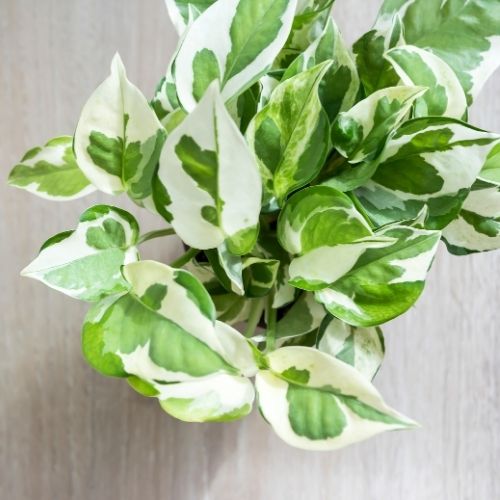
N’Joy Pothos is a delightful pothos cultivar known for the white and green variegation on its leaves. In this post, I’ll review easy N’Joy Pothos care, propagation, and everything else you’ll want to know about this unique plant!
What is Pothos N’ Joy?
N’Joy Pothos, or Pothos N’ Joy, is one of many beautiful pothos varieties (Epipremnum pinnatum).
This cultivar is actually a product of a breeding program, cultivated for “brighter variegation of the leaves and improved plant forms.”
It is “characterized by very compact growth, bright, distinctive green and white variegation.” You can read more about this cultivar in its United States patent.
The variegation on this pothos is “well-defined,” as the patent describes. It’s not like the marble queen pothos, with more speckled-looking variegation. Rather, the green parts stop before the white parts begin.
You might see the name spelled out as variations of N’Joy Pothos or Pothos N’ Joy. I couldn’t find exactly why it’s named N’Joy, but I assume it’s something along the lines of because you will “n-joy” looking at it!
Where can I buy an N’Joy Pothos?
You can easily find N’Joy Pothos cuttings and plants on Etsy. Check out this gorgeous N’Joy Pothos from one of my favorite Etsy shops!
How do you care for Pothos N’ Joy?
Here is a quick care overview, but this doesn’t mean you can skip the rest of my post! 🙂 Read on for all the critical care and propagation tips for success!
| Light: | Bright to medium, indirect |
| Water: | When the top inch is dry |
| Humidity: | Prefers high, is OK with average |
| Potting Mix: | Well draining |
| Fertilizing: | General fertilizer once a month during the growing season |
| Repotting: | Repot when rootbound |
| Climbing: | Yes |
| Pruning: | To control size and shape and remove dead foliage |
How much light does N’Joy Pothos need?
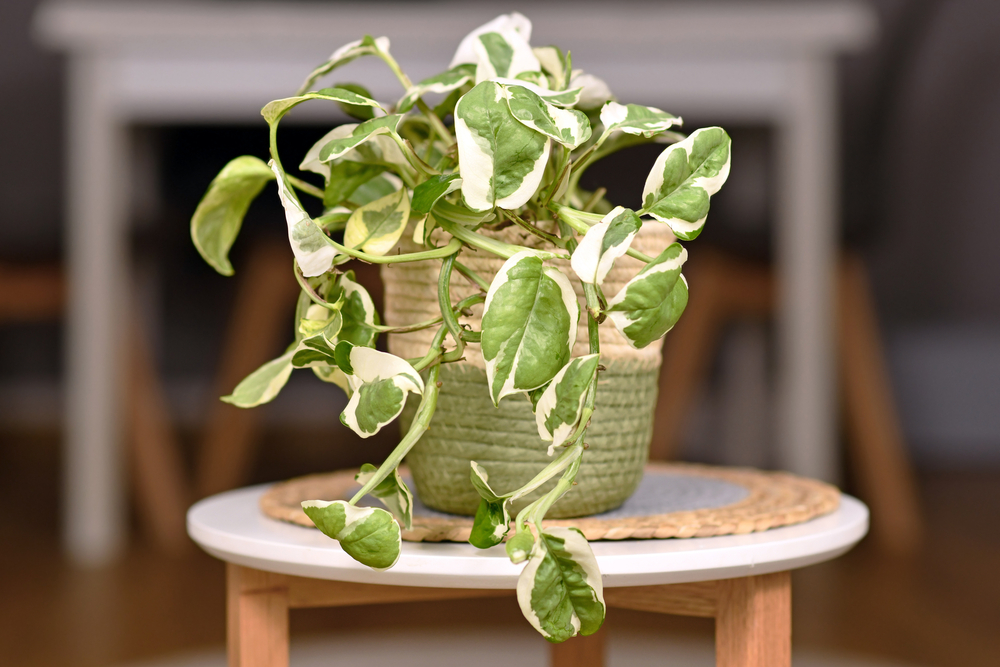
This pothos has similar care requirements to other pothos. It prefers bright to medium, indirect light. Do not let it sit in direct light or else its leaves can burn.
Variegated plants tend to lose variegation in low light.
However, since N’Joy Pothos was bred for its variegation, I’m not 100% sure how much variegation it’ll lose in low light. But, just something to keep in mind in case you do decide to keep this plant in low light.
If your plants are in need of some extra light, read my easy guide to grow lights for indoor plants. If you’re in a hurry, these are my absolute favorite grow lights!
Watering
Water this pothos when the top inch or so of the potting mix is dry. They don’t like to completely dry out but don’t let them sit in a soaking-wet pot either or you could put your plant at risk of root rot.
Be sure to stick your finger down into the potting mix to determine your plant’s moisture level and whether or not it needs to be watered. It’s better to go by this method rather than sticking to a strict watering schedule.
Do pothos like being misted?
Pothos are pretty forgiving, but they do prefer to live in a humid environment. Personally, I don’t find misting to be the most effective method.
I prefer using a humidifier, which is a low-maintenance and effective way to provide humidity to many plants at once!
This is one of my current favorite humidifiers because it lasts SO long (96 hours!) so it can go days without being refilled.
Potting Mix
Pothos, being one of the most low-maintenance plants to care for, will do just fine in a well-draining indoor plant potting mix. I always like to add in a few handfuls of perlite, too, for even more drainage.
Fertilizing
N’ Joy Pothos does not need fertilizer to thrive, but a little will still help. You can fertilize your pothos using a general houseplant fertilizer once a month during the growing season (spring and summer).
Buy a beautiful N’Joy Pothos here!

Repotting
Don’t leave your N’ Joy Pothos to get really rootbound. It won’t be happy. You won’t necessarily need to repot it every year, but check on it every year just in case.
If the roots are coming out of the drainage holes, or if it has stunted growth and looks generally unhappy, then it’s time to repot.
To confirm if it’s rootbound, you can turn the plant on its side and slip it partially out of the pot to check on its roots. If they are all in a big coil around the outside of the soil, then it is rootbound and, yes, time to repot!
Repot your plant in one the next size up from its current pot that has good drainage. Try to only repot in the spring or summer, if possible.
I really love terra cotta pots because they dry out quicker putting your plant at less risk of root rot!
Climbing and Support
N’Joy Pothos uses aerial roots to climb. Even though you can grow your pothos perfectly fine as a tabletop plant or in a hanging basket, climbing plants thrive to their full potential when given something to climb.
Here is a stackable moss pole I recently purchased for another climbing plant. I especially love that it’s stackable because it’s so easy to add more length to the pole once your plant outgrows it!
Providing your climbing plants with support will help them grow larger and stronger!
As part of your watering routine, mist the moss pole so that your N’Joy’s aerial roots can get a drink, too.
Pruning and Maintenance
Vining plants tend to get leggy, meaning long, stretched-out vines with fewer leaves. This is usually due to lack of light—the plant is trying to stretch out to grow towards more light.
To correct any leggy vines, use a clean pair of scissors to cut just above a node. Not only will this remove the leggy vine, but cutting above a node will encourage new growth.
(Cutting above a node means the node is NOT included on the part you cut off.)
Now, N’Joy Pothos is bred to be more compact than other pothos, so I’m not sure the extent of the legginess you’d actually experience. But it’s helpful to keep in mind for other vining plants, too.
Aside from this, occasional yellow leaves on your pothos are normal. Remove any yellow or dying leaves once they can be gently plucked away.
N’Joy Pothos problems and pests
Pests
Pothos are not particularly susceptible to pests, but they are sometimes affected by spider mites, mealybugs, and scale.
Check regularly underneath leaves and in crevices for pests.
I really like Bonide’s insecticidal soap and their Bonide Systemic Insect Control for help with pest control, which both work on a range of pests. Always read the instructions on the label first, and use caution if you have pets.
Pothos N’ Joy yellow leaves
Whenever I’ve had yellow leaves on my pothos plants, I’ve found the cause to be overwatering.
However, other common causes for yellow leaves on pothos are underwatering, too much light, or occasionally, too little light (the last one probably won’t be the case unless you have it in a very dark corner).
Stick your finger in the potting mix to determine your plant’s moisture level and evaluate your watering routine—when was the last time you watered? Adjust your routine if needed.
If watering doesn’t seem to be the problem, consider the amount of light your plant receives daily. Remember, they won’t be happy sitting in direct light.
Brown/Crispy leaves
On pothos, this is commonly caused by too much direct light, but can sometimes be caused by too much or too little water, too much fertilizer, or low humidity.
Move your plant out of direct light if it’s receiving any.
If that’s not the problem, stick your finger in the potting mix to determine your plant’s moisture level and evaluate your watering routine—when was the last time you watered? Adjust your routine if needed.
If you are frequently fertilizing your plant, remember pothos don’t need a lot of fertilizer, so ease up!
Last, although they are pretty resilient to drier air, try giving your plant some humidity if the air is REALLY dry.
How do you propagate Pothos N’Joy?
You can propagate your N’Joy Pothos in water or in potting mix. Both are easy to do, so it’s mainly a matter of preference on your part!
Propagate Pothos N’Joy in water
To propagate your N’Joy in water, identify a piece of vine with a few leaves and a few nodes (where the leaves and roots grow out of the stem). Take a pair of clean scissors and cut about a quarter-inch below a node.
Cutting below a node means you’ll include the node on the cutting. It’s important to include because that’s where new roots will sprout from.
Put the cutting in a jar of room-temperature water, making sure at least one node, more if possible, is under the surface. If there are any leaves under the surface, gently remove them.
Place the jar in an area that receives bright, indirect light. Fill the water up when the level gets lower and replace it completely once a week or so in order to keep it clean.
You should see tiny roots start to develop within the first week or two, but it will be at least a few weeks until the roots are long enough to transfer the cutting into potting mix.
I usually like to wait until the roots are around three inches long.
Once you transfer your cutting into potting mix, you can give it a good watering and care for it like a normal plant!
You can leave pothos in water permanently, too. It just won’t grow as fast.
Propagate Pothos N’Joy in potting mix
To propagate your N’Joy in potting mix, start with the same first step to take a cutting.
Here it is again: Identify a piece of vine with a few leaves and a few nodes (where the leaves and roots grow out of the stem). Take a pair of clean scissors and cut about a quarter-inch below a node.
Cutting below a node means you’ll include the node on the cutting. It’s important to include because that’s where new roots will sprout from.
Place the base of your cutting into a small container with moistened potting mix. Make sure at least one node, more if possible, is buried. Don’t bury any of the leaves.
Place the cutting in a location with bright, indirect light. You can also put a clear plastic bag over the top which will help to lock in beneficial humidity. Just remove it every day or so in order to let in fresh air.
Keep the potting mix moist but not wet as the roots develop. You can do this by misting the potting mix as needed.
It will be at least a few weeks before a new root system develops. After about a month, you can test this by giving the cutting a very gentle tug.
If there is resistance, a root system has developed and you can start caring for it like a normal plant.
If the root system hasn’t developed, that’s OK! Keep caring for your cutting and be patient 🙂
Growth rate and size
The U.S. patent for this plant that I linked to at the beginning of this post states its growth rate is “rapid.”
In the patent, they describe its size, but the age of the plant described is 22 weeks, and they don’t describe how big it can actually end up. However, pothos, in general, are known to grow several feet in a single year if grown under optimal conditions.
Is N’Joy Pothos toxic to cats and dogs?
Yes, pothos are toxic to pets, so be sure to keep your N’Joy and any other pothos out of your furry friends’ reach.
Buy a beautiful N’Joy Pothos here!
More pothos posts
Big pothos fan? Me too! Check out my care and propagation guides for these other pothos varieties:
- Shangri La Pothos
- Manjula Pothos
- Neon Pothos
- Marble Queen Pothos
- Cebu Blue Pothos
- Golden Pothos
- Satin Pothos
- 13 Pothos Varieties That You Can Easily Care For
Leave a Reply