
This post contains affiliate links. I will earn a small commission, at no extra cost to you, if you make a purchase through these links.
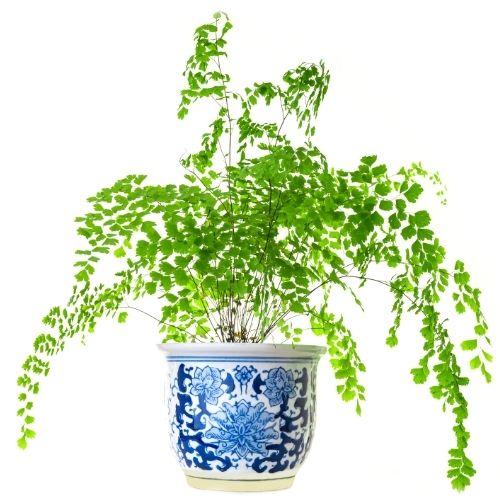
Maidenhair ferns are loved for their beauty but sometimes disliked for their high-maintenance care requirements. However, I like to think of them more as misunderstood rather than high maintenance. In this post, I’ll review exactly how to care for maidenhair ferns indoors and how to propagate them as well.
The maidenhair fern genus is actually made up of about 250 different species, with maidenhair being the common name. This genus is found in various countries all over the world, including right here in North America.
Can you grow maidenhair ferns outside?
Yes, maidenhair ferns are grown as both outdoor and indoor plants. Outside, they are commonly used as ground cover. In their native habitat, they are either lithophytic (growing out of cracks in rocks) or terrestrial (growing out of the ground), but not epiphytic (growing on the surface of another plant) like some other popular ferns.
Where can I buy a maidenhair fern?
You can easily find a maidenhair fern on Etsy. Check out this beautiful maidenhair from one of my favorite Etsy sellers!
How do I care for my maidenhair fern?
Ultimately, the key to successful maidenhair fern care is maintaining proper soil moisture, but I’ll review all aspects of this plant’s care below.
How much sun do maidenhair ferns need?
Provide your fern with bright, indirect light. Direct light will hurt its foliage, while low light will lead to little and sorry-looking growth.
If your fern needs more light, artificial light can help. Check out my two favorite grow lights below:
Just make sure the light isn’t too close to your fern. You’ll need to experiment with what your plant likes.
For more lighting help, see my guide to natural light for indoor plants and my guide to grow lights for indoor plants.
Watering
Maidenhair ferns should be moist but not wet. The soil should be consistently moist. This means you shouldn’t water it a ton one day and then let it completely dry out before watering again.
Yes, consistent moisture is tricky, but key. To accomplish this, you might have to water every few days or even every other day depending on how fast your fern starts to dry out. Constantly feel the soil to figure out if it needs more water. Become one with your fern!
Humidity
In general, ferns like humidity, and maidenhair ferns are no exception! There are a few ways to provide humidity to your plants, with using a humidifier being one very easy and effective way.
Check out my post on creating humidity for houseplants for more easy methods.
I do want to add that many people think maidenhairs will never survive without humidity. While humidity is very helpful, soil moisture is the real key to keeping this plant happy.
Potting Mix
Your fern’s potting mix should hold some moisture while also being well draining so that your plant does not stay soaking wet. A high-quality indoor plant potting mix with some added perlite should work fine, but adding in some compost for nutrients and richness will also help.
Fertilizing
You can use a balanced liquid houseplant fertilizer, diluted to half-strength once a month during the growing season (spring and summer).
Maidenhair ferns don’t need a lot of fertilizer, so don’t overdo it or you could end up harming your plant.
Repotting
Instead of repotting on a set schedule, repot your maidenhair fern when it becomes rootbound.
Signs of a rootbound plant include roots coming out of the drainage holes and stunted or sorry-looking growth (providing your care routine is not the problem). You can confirm rootbound-ness by gently slipping the plant out of its pot and observing the roots. If they are in a heavy coil around the outside of the soil, the plant is rootbound.
Repot your plant in a pot one size up and make sure it has good drainage. It’s best to repot in the spring and summer only, if possible.
Pruning and Maintenance
Losing a frond here and there is normal. If your fern is unhappy and losing a more significant amount of growth, you cut back any damaged or dying fronds using a pair of clean scissors. Eventually, you will see new little fronds growing in.
As tricky as maidenhairs can be, they make up for it by growing back pretty easily.
Common Problems
Maidenhair ferns are not particularly susceptible to pests but common problems you might encounter include:
- Root rot – Usually due to overwatering. Make sure you are checking soil moisture before you water your plant.
- Dried-up, shriveled, or brown fronds – Usually due to underwatering OR too much direct light. Again, make sure you are checking soil moisture regularly. You should not let your fern dry out. Also, don’t place your fern in direct light.
- Sorry-looking or weak growth – Commonly caused by too little light. Be sure you are giving your fern bright, indirect light.
Maidenhair Fern Propagation
Maidenhair Fern Propagation by Division
This is the easiest way to propagate your maidenhair fern. Note that it should be done only on a mature plant.
Remove your fern from its pot and, using a clean, sharp knife, divide the fern (soil and all) into sections. How many sections can depend on how large your fern is and how many additional plants you want. You should, however, make sure each section has at least a few fronds each.
After you divide your fern, gently untangle any roots and fronds and pull the sections apart. Pot up each piece into their separate pots. Then, care for each new fern as you normally would.
Your newly divided ferns will probably be shocked and may lose a few fronds. Don’t worry! Give it some time to adjust, and remember, if given proper care your plant should grow new fronds with no problem.
Maidenhair Fern Propagation by Spores
A mature and healthy fern will develop spores that look like brown dots on the leaves, so don’t worry, those aren’t pests.
Propagation through spores is a lot harder to do than division and even if you are successful, it will take a long time. However, it can still be fun to try!
Remove a frond that has many spores and put it in a paper bag. After a few days, some spores should have fallen off and collected in the bag.
Sprinkle your spores out on top of a container with moistened potting mix. Place a clear plastic bag over the top to help lock in moisture and humidity.
Put the container in bright, indirect light. The potting mix should be kept moist at all times.
It will take a few months for the spores to germinate and develop. You might have to move them to a bigger container as they grow. It can take a year or longer for the actual fern to develop and grow. Patience is key. If you’ve got the patience, go for it!
Additional Information
Do maidenhair ferns die back in winter?
If kept outdoors, maidenhair ferns sometimes die back in the winter when it’s too dry or cold, but they usually come back in the spring. You should not experience this indoors, though, as long as you’re providing it with proper care.
Are maidenhair ferns toxic to cats and dogs?
Maidenhair ferns are non-toxic to cats and dogs, but it’s always best practice to keep all plants out of your furry friends’ reach.
More Fern Posts
If you’re a fern lover, check out my posts on staghorn ferns and bird’s nest ferns. They are epiphytic ferns and not directly related to maidenhair ferns…but ferns nonetheless!

Anita shull says
I need a very small maidenhair 2” pot would be ideal but likely not available(too
Small to keep hydrated). So if I divide a 6” or 4”pot if maidenhair fern, do
You think this would work? If you had a 3” or 4” maidenhair certainly I would like that. Please advise me. Thanks much, Anita