
This post contains affiliate links. I will earn a small commission, at no extra cost to you, if you make a purchase through these links.
While Hoya bella is one of many beautiful Hoya species, this particular species is a little different from many other Hoyas and unique in its care requirements. In this post, I’ll review easy Hoya bella care and propagation.
Hoya bella is actually a subspecies of Hoya lanceolata, but instead of “Hoya lanceolata subsp. bella,” it is commonly referred to simply as “Hoya bella.”
Hoya bella is an epiphyte (meaning it grows on the surface of another plant, like a tree), but its leaves are only slightly succulent so it doesn’t like to totally dry out like other Hoyas. It is native to Myanmar and Northeast India and prefers slightly cooler temperatures.
Are Hoya plants easy to grow?
Yes! Hoyas are known for being low-maintenance plants, but slow growers, which often makes people think they are hard to grow. Hoya bella, however, grows much faster than other Hoyas.
Where can I buy a Hoya bella?
You can easily find lots of Hoya bella plants for sale on Etsy!
Check out this Hoya bella plant for sale from one of my favorite Etsy sellers.
How do you care for a Hoya bella?
An important part of Hoya bella care is not letting them dry out in between waterings (which is something many other Hoyas prefer), and not giving them too much light. Read on for all your Hoya bella care questions answered.
Do Hoyas bellas like sun or shade?
Hoya bellas prefer dappled shade. This is more difficult to recreate indoors because outdoors, dappled shade typically refers to light coming through trees.
Indoors, medium, indirect light will work for Hoya bella and they will even be fine in low light. Just don’t place them in direct sun.
Note that variegated plants, like the Hoya bella variegata, prefer more light in order to keep their variegation.
Although Hoya bella doesn’t like bright light, that doesn’t mean NO light. If you don’t have enough light in your home, you might want to consider grow lights.
I’ve used many different grow lights, but this clip-on, gooseneck grow light continues to be my all-time favorite because it is extremely easy to position in just about any angle you need it to reach!
Do Hoya plants like direct sunlight?
No, Hoyas do not like direct sunlight, and Hoya bella definitely should not be placed in direct sunlight.
Watering
Water your Hoya bella when you feel the top two inches getting dry. Unlike some other Hoya species, this one doesn’t like to totally dry out.
Although the soil should be kept moist, be careful not to overwater your plant or you could put it at risk of root rot. To help avoid this, always stick your finger into the potting mix first to feel the moisture level.
Humidity
Hoya bella does well in a more humid environment. There are many easy ways to create humidity for houseplants, with using a humidifier being one of the easiest.
My post on how to create humidity for houseplants has more easy methods and step-by-step guides.
Potting Mix
Since Hoya bellas are epiphytes and grow on trees in the wild, they prefer a well-draining and loose potting mix. They don’t need to be tightly packed into their pots.
A mix of perlite, bark, and indoor plant potting mix, or just indoor plant potting mix and lots of perlite will work fine for this plant.

Fertilizing
Hoya bella doesn’t require a lot of fertilizer and therefore, overfertilizing it could end up harming the plant. To fertilize this plant, use a general houseplant fertilizer diluted to half-strength once a month during the growing season (spring and summer).
Repotting
Hoya bella doesn’t mind being somewhat rootbound and also has a delicate root system, therefore it shouldn’t be repotted often unless it really needs it.
If you see roots coming out of the drainage holes or if your plant’s growth is suddenly stunted (providing your care routine is not the problem) these are signs that it needs to repotted.
Repot your plant in one the next size up from its current pot that has good drainage. Try to only repot in the growing season (spring and summer), if possible, and don’t repot your Hoya if it’s in bloom.
Climbing and Support
While many Hoyas climb, Hoya bella is actually NOT much of a climber. You can put them on a small trellis if you like, but they are more often found in hanging baskets.
Pruning
Pruning is not necessary, but if you’d like to fix any leggy vines or control your plant’s appearance, you can use a pair of clean scissors to prune back the vines. Just don’t prune too much at once or you could shock your plant.
Usually, a plant grows stretched-out vines with fewer leaves (leggy vines) when they’re trying to reach out to find more light. Pruning will not only remove the leggy vines but help to encourage new growth.
Do not prune off the peduncles (where your plant flowers) because Hoyas flower from the same place every time. Removing the peduncle will remove the Hoya’s ability to flower in that spot.
Flowering
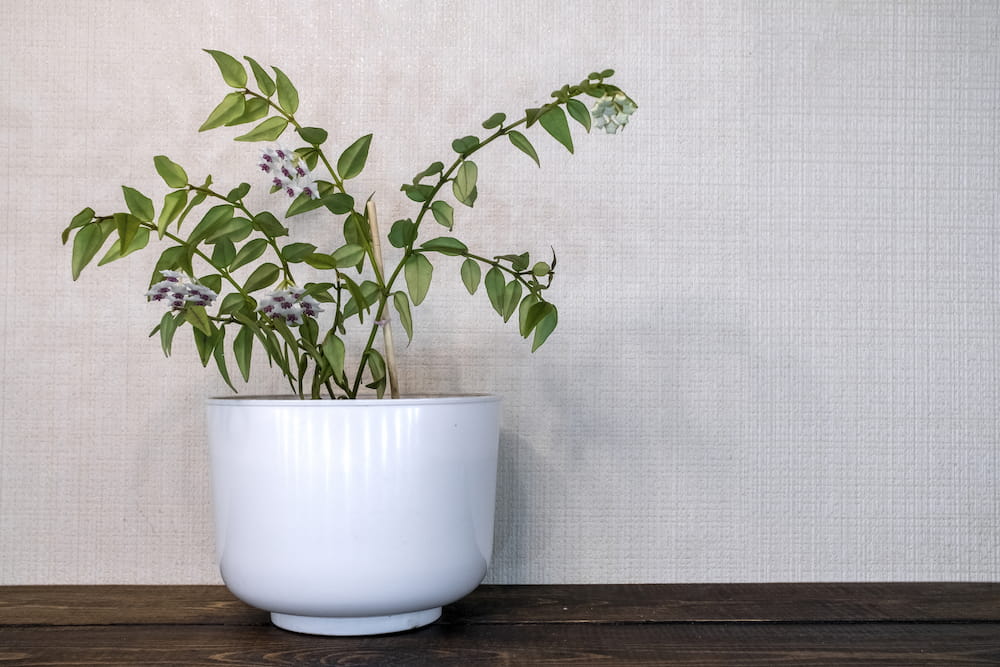
Like other Hoyas, Hoya bella grows beautiful white and pink flowers that resemble little clusters of stars.
Sometimes, these blooms seem to occur randomly or not at all which is frustrating for some Hoya owners. However, there are a few things you can do to encourage flowering.
- First, you need a mature plant. A baby plant will not flower.
- Don’t remove the peduncles (where your plant flowers) because they flower from the same spot each time.
- Provide it with brighter light if you have it in low light. Just don’t give it direct light.
- Provide more humidity.
- Use a fertilizer with a higher middle number—the “P” in the N-P-K ratio, which stands for phosphorus. Phosphorus can help encourage blooms.
- Allow the plant to be somewhat rootbound.
Problems and Pests
Common Hoya bella problems include:
- Yellow leaves and leaves falling off – This is most likely due to overwatering, which is surprisingly easy to do on a plant that likes to remain moist since it requires more frequent watering. Always stick your finger into the soil first to feel for moisture before watering your plant.
- Wrinkled and shriveled leaves – This typically means your Hoya is too dry. You can confirm this by feeling the soil for moisture. Since Hoya bella isn’t as succulent as other Hoyas and therefore doesn’t hold as much water, it will definitely need a good, long drink!
Common Hoya bella pests include:
- Mealybugs – Read my post on how to get rid of mealybugs for more help.
- Spider mites – I like this spray from Bonide for help getting rid of spider mites. Always read the instructions on the label and use caution around pets and children.
Hoya Bella Propagation
Hoya bellas can be propagated in water or in potting mix. In both methods, try to take a few cuttings if you can to increase your success rate.
Hoya Bella Propagation in Water
To propagate your Hoya bella in water, identify a vine that has a few sets of leaves. Take a pair of clean scissors and cut off the vine just below a node. A node is where the leaves and roots grow out of the stem and where new roots will sprout from on the cutting.
Place the cutting in a jar of room-temperature water, making sure at least one node is under the surface but that no leaves are under the surface. Place this in medium, indirect light.
Replace the water as needed to keep it clean, and fill it up when the water level gets lower.
After a few weeks, once the roots are a few inches long (two to three), you can transfer the cutting into its permanent pot. Then, give it a good watering and care for the plant how you normally would.
Hoya Bella Propagation in Potting Mix
You can follow the same general process, but using potting mix instead of water. In this method, you won’t have to worry about transferring the cutting out of water later on!
Identify a vine that has a few sets of leaves. Take a pair of clean scissors and cut off the vine just below a node. A node is where the leaves and roots grow out of the stem and where new roots will sprout from on the cutting.
Plant the cutting into a pot with moistened potting mix, making sure at least one node is buried but that no leaves are buried. Place this in medium, indirect light and keep the potting mix moist, but not wet, as the roots develop.
You can also put a clear plastic bag over the top of the pot to help create beneficial humidity. Just remove it every other day or so to let in fresh air.
In a few weeks, you can test the cutting to see if a root system has developed by giving it a very gentle tug and feeling if there is any resistance. If you feel resistance, you can start caring for the plant how you normally would.
Additional Information
Is Hoya bella toxic to pets?
Hoya bella is non-toxic to pets, but keep in mind it’s always better to just keep all plants out of your furry friends’ reach.
Growth Rate and Size
Many Hoyas are known for their slow growth, but Hoya bella is a medium-to-fast grower.
As a houseplant, you can expect its vines to grow out to about two to three feet. The vines stick out in every which direction making for a fun and unique-looking plant!
Shop now for a beautiful Hoya Bella for your collection!
Rosalie E Petsu says
I have a hoya bella and stop blooming years ago, I did not repot it or fertilized it, what can I do?
Thank you for any tip you can give me. I need to see the beautiful blossoms again.
Sincerely,
Rosalie.
Julie - Houseplant Aficionado says
Hi Rosalie – I would try making sure it’s in bright, indirect light as well as adding some increased humidity, but remember, ultimately we cannot force a hoya to bloom.
Thuy says
Hi Julie,
I have a Hoya bella that is growing quite well with many peduncles full of buds but they would dry up and drop before blooming. I have it on a shelf near a east window and only water with rainwater! Please help!
Julie - Houseplant Aficionado says
Hi Thuy – I’m sorry you’re experiencing this with your Hoya. It’s hard to say, but I would check on a few things: Your plant might not be getting enough light; I would also check your watering and make sure you’re not under or overwatering; last, try giving it more humidity if you’re not already. Good luck!
Debbie says
Hi, great reading all these tips on bella probagation, but I have just purchased a luis bois 4 leaf cutting and its winter here in NZ I really need to know the best way to get it rooted ie; what is the best success rate in spagnum, leca or pumice or potting mix please, I need to know as soon as possible, do I put on heat with light etc? Thanks very much my email address below Debbie
Julie - Houseplant Aficionado says
Hey Debbie – You should be able to root your hoya in any of those mediums. Personally, I like to keep it simple and stick to potting mix, water, or sometimes sphagnum. If it’s very cold where you live then yes, I would try to provide the cutting with some additional warmth.
Jeannie says
I bought a Hoyas bella she sent it to me with a 8 in pot and the root system is a hand full. It will fit in a 4 in .I never had one so I used a 6 in pt will it work or should I put it in a little pot thank so much
Deena says
I want to propergate my Bella Hoya for my mum but I’m not following what you mean by taking a cutting.
Take a pair of clean scissors and cut off the vine just below a node. A node is where the leaves and roots grow out of the stem and where new roots will sprout from on the cutting.
Is it possible for you to send me a photo of the area you mean. Sorry for not quite understanding.