
This post contains affiliate links. I will earn a small commission, at no extra cost to you, if you make a purchase through these links.
Snake plants are well known for being very easy to care for and for being one of everyone’s favorite low-light tolerant plants. In this post, I’ll review easy snake plant care and propagation.
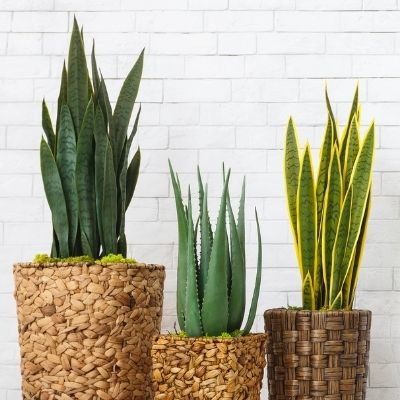
Snake plants are native to parts of Africa. They are also often referred to as Sansevieria (their genus) or their other common nickname, mother-in-law’s tongue. With about 70 different species, there is really a snake plant for everyone! Thick, thin, tall, short—you name it.
And, did you know that snake plants are actually succulents? They store water in their leaves and rhizomes. Rhizomes are modified parts of the stem that grow underground. Certain plants use them for water and nutrient storage and to produce new plants.
Where Can I Buy a Snake Plant?
You can find lots of snake plants available on Etsy. Check out this absolutely stunning snake plant from one of my favorite Etsy shops!
Snake Plant Care
How much light do snake plants need?
Medium, indirect light is ideal lighting for snake plants, although they can survive in low light and in bright light. Just don’t put them in direct light which could scorch the leaves. Snake plants are everyone’s favorite low-light plant even though they do best in medium light.
(Psst, did you know I have some helpful posts on light? If your home is just downright dark and your snake plant could use more light, check out my post all about grow lights. And, for help with finding just the right natural light for your snake plant, check out my easy guide to natural light.)
How often should you water a snake plant?
You should let your snake plant dry out between waterings. How often that will actually be depends on factors like your climate and light level. In hotter climates and in brighter light, the plant will dry out faster.
Remember, they store water in their leaves and rhizomes which is why they don’t need to be watered often! Snake plants do not like to stay wet, and, although they are relatively easy to grow, they are prone to root rot.
For more help on how to know when to water your houseplants, check out my watering guide.
Should I mist my snake plant?
Nope! Unlike many other houseplants, snake plants do not require additional humidity. In fact, they are extra sensitive to wet leaves and might start to rot if you mist them. There is no need to go above and beyond to provide this plant with humidity, and you definitely should not mist the leaves.
Potting Mix
Because snake plants don’t like to stay wet, they need a very well-draining potting mix that won’t get compacted. A succulent and cacti mix will work well. If you only have regular indoor plant potting mix on hand, it’s still a good idea to improve the drainage, such as by adding a few handfuls of perlite.
Fertilizing
Snake plants don’t really need to be fertilized, but if you’d like to fertilize yours, you can use a balanced, general indoor plant fertilizer. Only use it a few times throughout the growing season (spring and summer). They are slow growers and really don’t need much fertilizer.
Repotting
Snake plants are slow growers and they are also OK with being somewhat rootbound. Therefore, you shouldn’t need to repot them often. You’ll need to repot your plant every few years, and definitely repot it if roots are coming through the drainage holes or if the roots have cracked the pot.
Choose a pot that’s the next size up from its current pot and has good drainage. And, as a general rule, it’s always best to repot in the spring or summer if you can help it.
Pruning
You shouldn’t need to prune your snake plant aside from occasionally removing any dying leaves or leaves that have just fallen over, which every-so-often happens to snake plants. Simply use a pair of clean, sharp scissors or shears to cut the leaf off at the base. (Note: If it’s a healthy leaf that has fallen over, you can propagate it! We’ll cover that in the next section.)

Propagating a Snake Plant
Snake plants can be propagated through a few methods, including through leaf cuttings, a whole leaf, or by dividing the rhizomes.
Leaf cutting propagation
Use a pair of clean scissors or plant shears to cut a healthy-looking leaf away from the plant. Take the whole leaf, cutting it at the base. Now, cut the leaf into two-inch sections.
Let the sections callus over for a few days before planting them. (Important: Keep track of the bottom parts on each section.)
After a few days, plant the cuttings into your potting mix with the bottom parts down. The cuttings should be sticking up out of the potting mix, kind of like miniature snake plants. Then, water them and care for them how you normally would with a snake plant.
Whole leaf propagation
This method takes a lot longer than leaf cuttings. Use a pair of clean scissors or plant shears to cut a healthy-looking leaf away from the plant. Take the whole leaf, cutting it at the base. Place this in a clear container that is large enough to support the whole leaf, but only fill it a few inches with water, not so the entire leaf is underwater.
Place this in bright to medium, indirect light and replace the water when it gets grimy, once a week or so. Once the roots are a few inches long, pot up the leaf, water it, and care for it how you normally would with a snake plant.
Note that it can take months for the roots to fully develop, so this is not the way to go if you want quick propagation.
You can also take leaf cuttings (mentioned in the previous section) and propagate them with the water propagation method explained in this section. However, it can be difficult to keep the leaf cuttings standing up and not falling into the water.
Division
This is done by diving the rhizome. A rhizome is a modified part of the stem that grows underground on certain plants. They store water and nutrients and produce new plants.
To divide your snake plant, remove the plant from its pot. Once you can see into the potting mix, you’ll notice the thick white rhizomes where each separate plant is growing from.
You can separate two parts of a mature plant or separate a pup that has sprouted out of a mature plant. To separate, take a pair of clean, sharp shears or a clean, sharp knife and cut in the middle of a rhizome.
As you’re doing this, make sure each side of the plant being cut is still left with some of the rhizome as well as some roots (meaning don’t cut the entire rhizome away from one part of the plant). If there are no roots then you shouldn’t separate that part of the plant.
Gently untangle any tangled roots, keeping them as intact as possible. Pot the separated plants into a pot with good drainage. You can plant them in separate, smaller pots or all together in one larger pot. Once you’ve potted up your plants, water them and care for them as you normally would.
Additional Information
Are Snake Plants Toxic to Cats and Dogs?
Yes! Snake plants are toxic to cats and dogs so be sure to keep them out of your furry friends’ reach!
Leave a Reply