
This post contains affiliate links. I will earn a small commission, at no extra cost to you, if you make a purchase through these links.
Pilea peperomioides—pancake plant, UFO plant, Chinese money plant, friendship plant, pass-it-on plant—whichever nickname you prefer, this plant deserves them all! It is one of the easiest plants to propagate and a lot of fun to grow. In this post, I’ll review Pilea propagation and care.
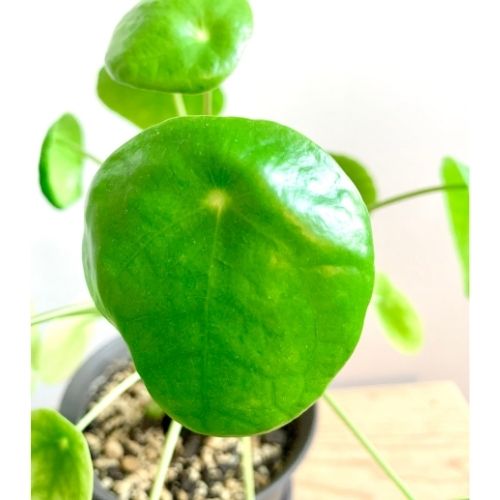
Pilea peperomioides is an extremely unique-looking houseplant. After seeing one for the first time, you’re likely to remember it forever. It has bright-green to dark-green round leaves that grow on the ends of petioles, which grow off of a central trunk.
Although it may not looks like one, this plant is a succulent. It stores water in its parts and therefore doesn’t need to be watered too frequently—we’ll discuss that more below.
Pilea peperomioides is native to parts of China, however, it’s now very rare to find in its natural habitat.
And speaking of rare, although these plants used to be very difficult to get one’s hands on, they are a lot more common today as houseplants.
I’m not sure about other countries, but in the United States, up until a few years ago, pretty much the only way to get one was if you knew someone who had a plant they could propagate for you. In fact, they are known for being easy to propagate and share with friends—hence “friendship plant” and “pass-it-on plant.”
Where can I find a Pilea peperomioides?
You can easily find Pilea peperomioides on Etsy. Check out this one from one of my favorite Etsy shops!
How do you care for a Pilea peperomioides?
How much sun does Pilea peperomioides need?
Pilea peperomioides perfers bright, indirect light. Too much direct light will burn the leaves. Rotating this plant for even growth is very important. When I went on vacation and wasn’t around to rotate this for almost a week, I came back to the Leaning Tower of…Pilea!
These plants do well under artificial light, and I currently have mine under a grow light since I only have medium-to-low natural light throughout my entire home. Check out my post on grow lights for more information on purchasing grow lights for your plants.
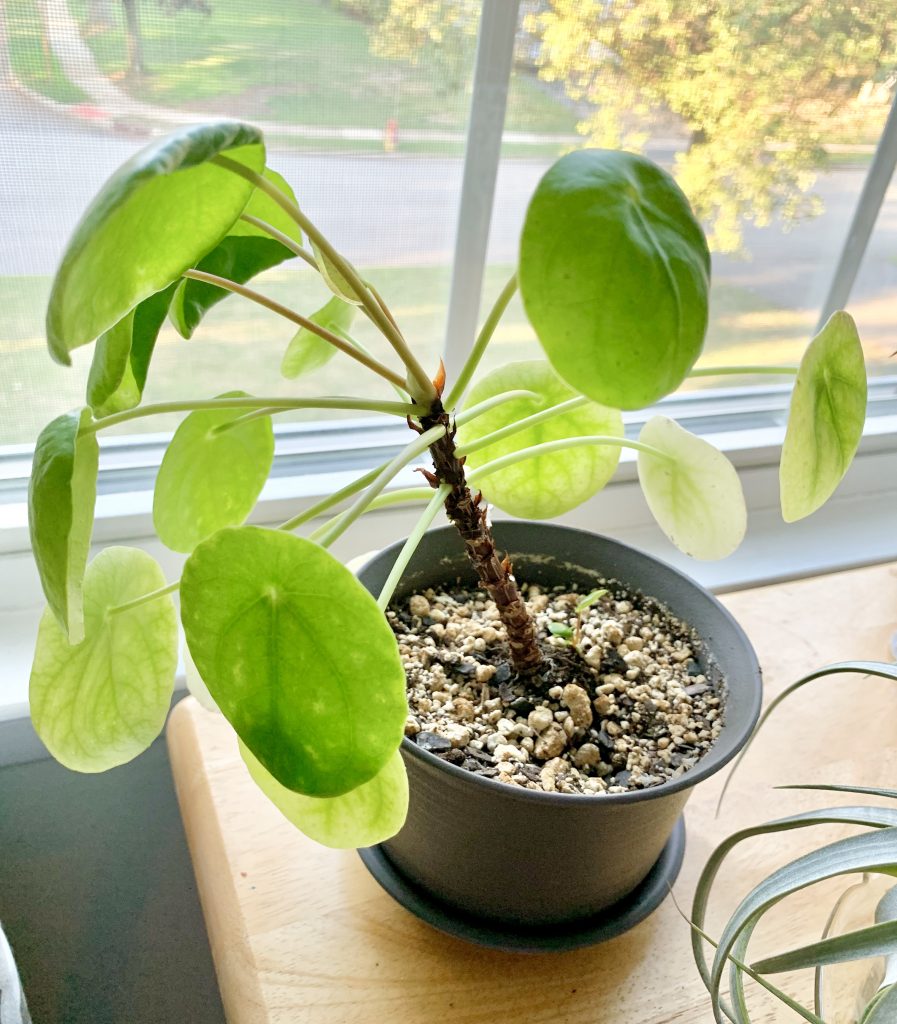
Why are my Pilea peperomioides’ leaves curling?
Leaf curl is a common problem and can be caused by insufficient light or stress from too much direct light, so just assess your plant’s environment to help determine the cause.
In addition to light conditions, leaf curl can also be caused by consistently too-dry soil or overwatering, so assess your plant’s potting medium, too!
How often should you water Pilea peperomioides?
As a succulent, these plants like to mostly dry out in between waterings. Water your plant when the soil is dry about two inches down.
Why are my Pilea peperomioides’ leaves drooping?
Your Pilea may simply be too dry. Feel the soil. If it’s dry, give your plant a good watering.
Leaf droop is also a symptom of root rot from overwatering. This is why it’s important to check the soil first to help determine the cause of the leaf droop.
Humidity
Where it differs from other succulents is that Pilea peperomioides is a humidity-loving plant. There are many simple ways to create humidity for plants, and I review them step by step in my post on easy ways to create humidity for houseplants.
Potting Mix
Use a well-draining potting mix that doesn’t hold moisture. I have mine potted in a general houseplant potting mix with some added handfuls of perlite to help with drainage. You can also pot yours in a succulent potting mix.
Fertilizing
Pilea peperomioides respond well to fertilizer and you’ll see them push out a lot more leaves every time you fertilize. However, be careful not to overdo it. You can fertilize your Pilea once a month during the growing season (spring and summer), with a balanced houseplant fertilizer diluted to half strength.
Repotting
Generally, repotting your Pilea every two years is fine. If it has grown significantly, choose a pot that’s the next size up from its current pot. They don’t need a lot of space so the pot shouldn’t be too big for the plant. Therefore, if your plant hasn’t grown much, you might be able to use the same pot and just change out the potting mix. Make sure it has drainage holes, too.
Pruning
This plant doesn’t need to be pruned except to remove any dead or dying leaves. Remove yellow or brown leaves once they can be gently plucked away from the plant (not forcefully pulled off). You’ll probably notice this happening on a few of the bottom leaves. Don’t worry, it’s normal to lose a few bottom leaves here and there.
Pilea Propagation
Pilea peperomioides was given the nicknames “friendship plant” and “pass-it-on plant” because it’s known for being easy to propagate. The easiest way to propagate Pilea peperomioides is through the small offsets (baby plants) that your plant will give off. If your plant is still juvenile it probably won’t give off any offsets, so don’t be frustrated if this is the case for you. Also, don’t propagate this plant the second you see a new, microscopic offset. Give it some chance to grow. The bigger it is, the better chance it has of surviving.

Pilea Propagation in Water
Cut the offset away from the mother plant with a clean, sharp knife, doing your best not to damage any roots. Place the baby into a container of water. You might have to get creative with your container to keep the whole plant from falling in the water. Only the stem and any roots should be submerged. A propagation station with test tubes works well for this.
Place in bright, indirect light. Replace the water if it starts to get grimy and add more water when it starts to evaporate. In a few weeks, you should notice roots have grown and you can transfer your baby plant into its permanent pot with potting mix. Make sure the pot isn’t too large—you’ll probably need a pretty small pot starting out.
Pilea Propagation in Soil
If you cut away the baby from the mother plant and there are already established roots, you can place your baby directly into some moist potting mix and skip the water. You should start to see new growth on the baby within a few weeks. However, I find it’s easiest to propagate smaller plants in water, even if they already have some roots.
Pilea Propagation by Leaf
Pilea peperomioides propagation is also possible to do through one of the leaves, but this is definitely more difficult. Use a clean, sharp knife to cut away one of the leaves, and be sure to include a little piece of the trunk on the end of the petiole, so you will have the leaf, the petiole, and a little piece of the trunk sticking off the end. Then, put the cutting in a jar of water and follow the regular process for water propagation.
Additional Information
Is Pilea peperomioides safe for pets?
Pilea peperomioides is non-toxic to cats and dogs, however, it’s best practice to keep all plants out of your furry friends’ reach.
How big do pilea plants get?
In the right conditions, Pilea peperomioides will grow quickly, and they will typically grow to be about a foot tall.
Jo-Anne Lemaire says
Hello, Julie. My pilea peperomiodes has had a few difficulties, mostly those that I’ve learned from your article that mean it could have been overwatered or not got enough water. Mine seems to be a drama queen, but I still like her so I’m trying to save her. You suggested leaf cuttings as a way to go, but without destroying my plant and maybe suffering failure, I am also wondering if I can take a stem cutting, and could it be rooted in water or would a soil mix be a better choice. It was hard to find this plant locally and I haven’t seen more in the year since I bought this one. Hoping you can help me. Thank you in advance.
Julie, Houseplant Expert says
Hi Jo-Anne – My response is a bit late, I hope your plant is OK now but in case you’re still dealing with this, yes, you can use a stem cutting and that can be rooted in water or soil. I personally prefer water propagation but either can work so it’s up to you!