
This post contains affiliate links. I will earn a small commission, at no extra cost to you, if you make a purchase through these links.
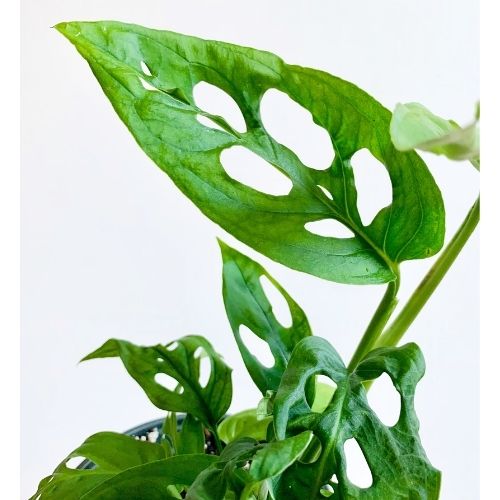
Monstera adansonii, also called the Swiss cheese plant, Swiss cheese vine, five holes plant, monkey mask plant, and Adanson’s monstera, is a statement-making plant known for its trailing vines and leaf fenestration.
In this post, I’ll review easy Monstera adansonii care and propagation!
How do you take care of Monstera Adansonii?
Caring for Monstera Adansonii is very similar to other tropical vining plants. Here are its basic requirements:
- It prefers bright, indirect light
- It does not like to dry out completely—water it when the top inch of the potting mix is dry
- Give it a moss pole to climb to help it grow larger
How much light does Monstera adansonii need?
Bright, indirect light is best for Monstera adansonii. This plant can tolerate lower light, but it won’t grow as fast and might have trouble developing fenestrations. Don’t place your plant in direct sunlight as it can burn the leaves.
Grow lights are extremely helpful if you don’t have enough light for your Monstera. In fact, they are literally a lifesaver (for your plant, anyway!).
At the moment, I keep nearly all my plants under grow lights.
I’ve used many different grow lights, but this clip-on, gooseneck grow light continues to be my all-time favorite because it is extremely easy to position in just about any angle you need it to reach!
When should I water Monstera Adansonii?
Water your Monstera adansonii when the top inch of the soil is dry. They don’t like to dry out completely but be careful not to overwater them either.
To prevent overwatering, be sure to stick your finger into the soil to feel for moisture to determine whether or not your plant actually needs water.
Why is my Monstera adansonii drooping?
If your Monstera adansonii’s leaves are consistently drooping, it’s possible you’ve either overwatered your plant and it’s starting to suffer from root rot, OR you’re not watering your plant enough and it’s thirsty.
Stick your finger down into the soil to feel for moisture in order to determine the cause.
Does Monstera adansonii like humidity?
Native to Central and South America, these plants thrive in humid conditions and will love some extra humidity added to their environment. There are a few easy ways you can do this, but my favorite is using a humidifier.
I really like this humidifier because it can last up to 96 hours, keeping my plants happy for a long time!
Temperature
Being native to warmer environments, Monstera Adansonii prefers warmer temperatures. However, it will be just fine in normal household temperatures.
Try not to let it get below 60 degrees Fahrenheit (about 15.5 degrees Celsius), or your Monstera won’t be happy. During the winter, move it away from cold windowsills or any drafts.
What kind of potting mix does Monstera Adansonii need?
A well-draining indoor plant potting mix is all the Monstera adansonii needs. I usually add an extra handful or two of perlite into my mix for more drainage.
Fertilizer
These plants aren’t heavy feeders, but they’ll still benefit from some fertilizer. To fertilize Monstera adansonii, use a balanced houseplant fertilizer once a month during the growing season (spring and summer).

Repotting
Repot your Monstera adansonii every one to two years in a pot the next size up from its current pot, and make sure it has drainage.
I really love terra cotta pots because they dry out quicker putting your plant at less risk of root rot!
These plants do not like to get very rootbound, so if you see roots coming out of the bottom of the pot, it’s definitely time to repot.
Another possible sign of a rootbound plant is stunted growth. In this case, you should gently take the plant out of its pot and examine the roots to determine if it is actually rootbound.
If it is, the roots will be swirled around the outside of the soil and bottom of the pot.
Pruning
Prune off any yellow, dying leaves once they can be gently plucked away from the plant.
Otherwise, pruning is not always required but is handy to control the size and shape of the plant. Vining plants tend to get leggy, which is when the vines become very long and stretched out with fewer leaves, usually due to the plant trying to reach out to find more light.
You can create a more bushy plant by pruning the vines to encourage new growth.
When pruning, use clean scissors to cut about a 1/4 inch above a node (where the leaf attaches to the vine). Cutting above a node means the node is NOT included in the part you cut off—it stays on the plant.
Monstera leaves and fenestration
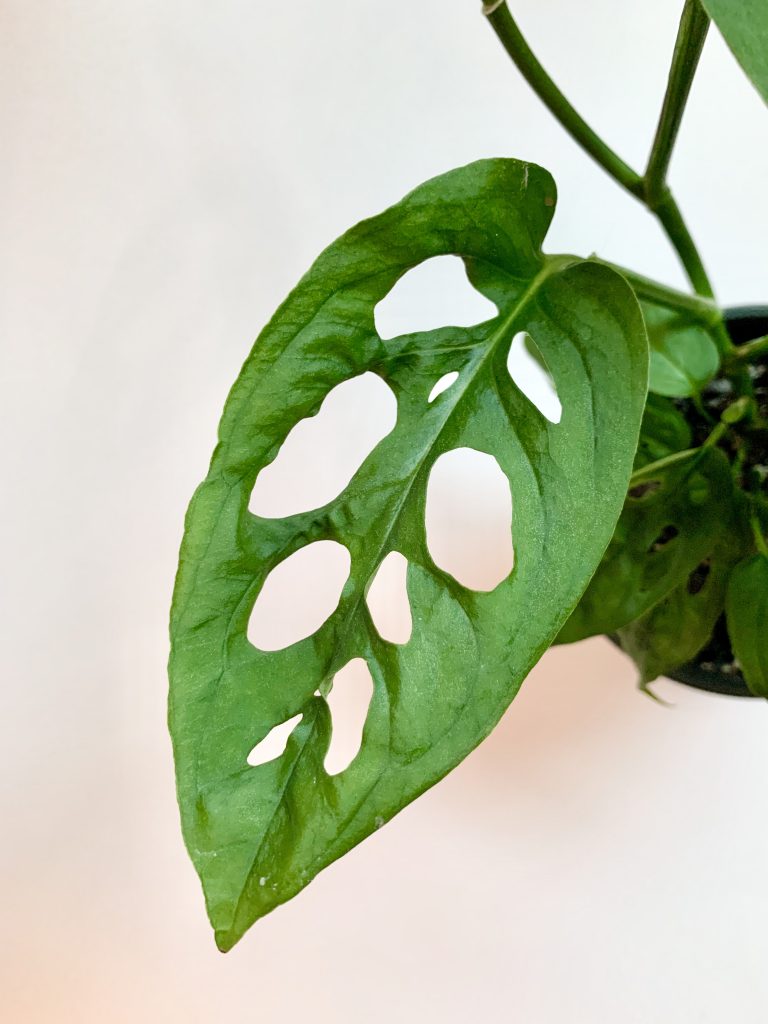
Monstera leaves are easily identifiable because of their splits and holes, also known as fenestration.
While there is currently not enough scientific evidence to point to an exact reason, researchers believe the fenestration on Monstera leaves helps the plant spread its leaf surface area out further to catch flecks of sunlight that make it through to the forest understory.
Some other possible theories are that it allows the plant to withstand strong winds and that it helps more water to come through to the plant’s roots.
Climbing and Support
In its natural environment, Monstera adansonii climbs using aerial roots. Aerial roots also help absorb nutrients, so putting them to use will only benefit your plant.
Allowing it to climb by giving it some form of support will help your plant to grow strong and healthy.
Here is a stackable moss pole I recently purchased. I can personally attest that my little adansonii is a LOT happier now that I’ve given it something to climb up!
As part of your watering routine, mist your moss pole where it meets your plant’s aerial roots so the aerial roots can get a nice drink, too.
Where can I buy Monstera adansonii?
You can easily find a Monstera Adansonii on Etsy. Check out this gorgeous Monstera Adansonii from one of my favorite Etsy shops!
Monstera Adansonii Propagation
Like many vining plants, Monstera adansonii propagation is relatively easy. This can be done in water or soil. You can even leave it in water permanently if you want, although it won’t grow as much as they would in soil.
Monstera adansonii propagation in water
- To propagate Monstera adansonii in water, use clean scissors to take a cutting with a couple of leaves off the mother plant, cutting about a 1/4 inch below a node (this means the node is included on the cutting). The nodes are where the new roots will sprout from.
- Remove any bottom leaves in order to leave a few inches of bare stem
- Put the cutting in a glass of water making sure at least one node is under the surface. Make sure none of the leaves are submerged.
- Place the cutting in a location with bright, indirect light.
- Be sure to change the water when it gets murky and refill it when you see the level getting lower.
- You should see little roots sprouting within the first week or two, but it might be a few weeks before you can transfer your cutting into soil.
- When the roots are a couple of inches long, transfer the cutting to its permanent pot. In my experience, two to three inches is long enough for the roots to be transferred.
- Once the cutting is transfered into its new pot, water it and care for it like you normally would!
Monstera adansonii propagation in soil (method one)
To propagate Monstera adansonii in soil, repeat the first step above. Here it is again:
- Use clean scissors to take a cutting with a couple of leaves off the mother plant, cutting about a 1/4 inch below a node (this means the node is included on the cutting). The nodes are where the new roots will sprout from.
- Remove any bottom leaves in order to leave a few inches of bare stem.
- Now, instead of putting the cutting in water, place it directly into moistened soil so that at least one node is buried. Don’t bury any leaves.
- Place the cutting in bright, indirect light and keep the soil moist, but not wet, as the roots develop.
- You can also place a clear plastic bag over the top to help lock in beneficial humidity. Be sure to remove the bag once a day to let in fresh air.
- It will take at least a few weeks before the root system develops and you notice any new growth on the cutting, so be patient!
- After a few weeks, you can test the cutting by giving it a very gentle tug. If you feel resistance, the roots have developed and you can treat it like a normal plant.
Monstera adansonii propagation in soil (method two)
Another method of Monstera adansonii propagation (and other vining plants) is to place the entire cutting down so it’s laying on top of the surface of the soil, with all the nodes facing down into the soil.
You can also cut the vine into small sections and do this instead of leaving it as one whole vine—just make sure each section has a node.
- Temporarily “fasten” the vine or sections to the soil using bobby pins or paper clips, if needed.
- Place the it in bright, indirect light and keep the soil moist, but not wet, as the roots develop.
- You can also place a clear plastic bag over the top to help lock in beneficial humidity. Be sure to remove the bag once a day to let in fresh air.
The nodes that are in contact with the soil will eventually take root this way, too!
What is the difference between Monstera obliqua and Monstera adansonii?
These two plants look somewhat similar. Obliqua leaves are very delicate, paper thin, and have more fenestration (holes) than actual leaf. It looks like the leaf part was almost an afterthought the plant had, like, “Oh, I should probably try to grow leaves, too!”
This post from House Plant Hobbyist has some nice images for reference.
Monstera adansoniis are more leaf than hole and are not as delicate. Obliquas are extremely rare, both in the wild and as houseplants, and extremely expensive. We’re talking thousands of dollars.
So, if you see a plant with a hefty price tag that is labeled as Monstera obliqua, always do your due diligence before purchasing. There is a chance it could actually be Monstera adansonii.
Is Monstera adansonii rare?
Monstera adansonii is no longer considered rare. While it used to be considered rare, or at least harder to get your hands on, now it can usually be found at many big box stores.
Is Monstera adansonii toxic to pets?
Yes, Monstera adansonii is toxic to cats and dogs. It may be called the Swiss cheese plant, but your furry friends should not be eating this one!
Are Monstera Adansonii easy to care for?
Yes, the Monstera Adansonii is extremely easy to care for. It’s perfect for a beginner who wants a unique houseplant! Its main care requirements are very basic:
- Bright, indirect light
- Don’t let it completely dry out—water when the top inch is dry
- Pot in a well-draining potting mix
- Provide with humidity and warmth
- Use a balanced houseplant fertilizer once a month during the growing season
- Repot every one to two years
- Provide it with a moss pole to climb
Buy a Monstera Adansonii aka the Swiss Cheese Plant here!
Julian says
Hi. I have my cuttings propagated and roots started to grow. Now, the jar was accidentally dropped while I was sleeping. Then the cuttings are all over the floor. As I checked the roots, they are dry and turned brown. Do you know what I should do next? Thanks!
Julie - Houseplant Aficionado says
Hi Julian – I would stick them back in water and try again—see if they will still grow. Make sure you give them bright, indirect light. Unfortunately, the only way to know for sure is to wait and see what happens.
Kaya says
Hi I got a cutting of the plant with two node, I am doing water method. 1 node has 2” long root and other has very small roots. Should I wait to plant in soil.
Caroline says
I just took the first cutting of my Adansonii, which I got as a cutting several months ago. This guide has significantly reduced my anxiety over the process. Thanks for the clear steps and multiple options for propagation!
Julie - Houseplant Aficionado says
So happy to hear that, Caroline! Good luck with your Adansonii! 🙂
LeahR says
How large a pot should I use for my plant? Also, should I add some perlite to improve drainage?
Julie - Houseplant Aficionado says
Hey Leah! It will depend on how large your plant is. You can see in my April update photo that my plant is getting pretty tall, but it’s actually only two vines in the pot, therefore, it’s happy in its 4 1/2 inch wide pot. Yes, perlite is always helpful. I always throw in an extra handful or two 🙂
Taylor Cowton says
Hi my adansonii only has growth coming out of each new leaf therefore I’m scared to cut the newest section off to propagate, as I won’t then get any new growth from the older part of the plant. Any help would be fab 🙂
Julie - Houseplant Aficionado says
Hey Taylor! I’m not sure I can picture what you’re describing when you say the growth is only coming out of each new leaf. However, it sounds like a young plant. I would wait until it gets a little larger and has a decent amount of healthy growth on it before trying to propagate it. You can help speed up its growth rate by giving it a moss pole and a little bit of fertilizer.
Daisy says
I already had a long length (3m) of Adansonii growing in water, but it had gotten so long that I felt it was time to cut in half. I used the rooted part to plant in some soil, and put the remaining top half of the cutting into water to grow root/become its own plant. My issue is that, the rooted part which I have placed into soil has been weeping liquid from the tip that was cut since I have potted it. I’m worried that this is not a good sign. What should I do?
Julie - Houseplant Aficionado says
Hi Daisy – It sounds like guttation, which is just the plant getting rid of water. It’s nothing to worry about!
Krystal says
I had some new leaves that were coming in and appear to be stuck. They have been halfway open for about a week and a half. I want to help open them without damaging the leaves. Any suggestions?
Julie - Houseplant Aficionado says
Hi Krystal – If they’re only halfway open I wouldn’t try to open them. Just continue to provide the plant with bright, indirect light, don’t let it completely dry out, and perhaps give it a boost with fertilizer.
Cat says
Hi I’m thinking of cutting and propagating my Adansonii to make more plants but will the mother plant still be able to produce more leaves? This doubt is preventing me from propagating all together. Thanks in advance!
Julie - Houseplant Aficionado says
Hi Cat – Yes, the mother plant will still grow more leaves (as long as you don’t cut the plant back to a nub!) and pruning it will encourage the mother to push out more growth. (Edit: I just uploaded a photo in the “Pruning” section of this post that might help you. You can see where I made the cut and how the vine kept growing!)
t. says
Hello!
I received an extremely
root bound and big adansonii. Do you think loosening the roots and dividing the plant would be too shocking?
Vanessa says
Hi if I cut off a section of my monstera adansonii, will new growth appear where I cut from?
Julie - Houseplant Aficionado says
Hi Vanessa – Yes, new growth generally comes from the node right below where you cut.
Alli Shih says
My monstera adansonii has outgrown its support and I need to replace it. How do I safely do this?
Labijo says
I got new adanonii variegated with 3 leave’s on. Let’s grow them with your tips. Anyway, thanks for the tips.