
This post contains affiliate links. I will earn a small commission, at no extra cost to you, if you make a purchase through these links.
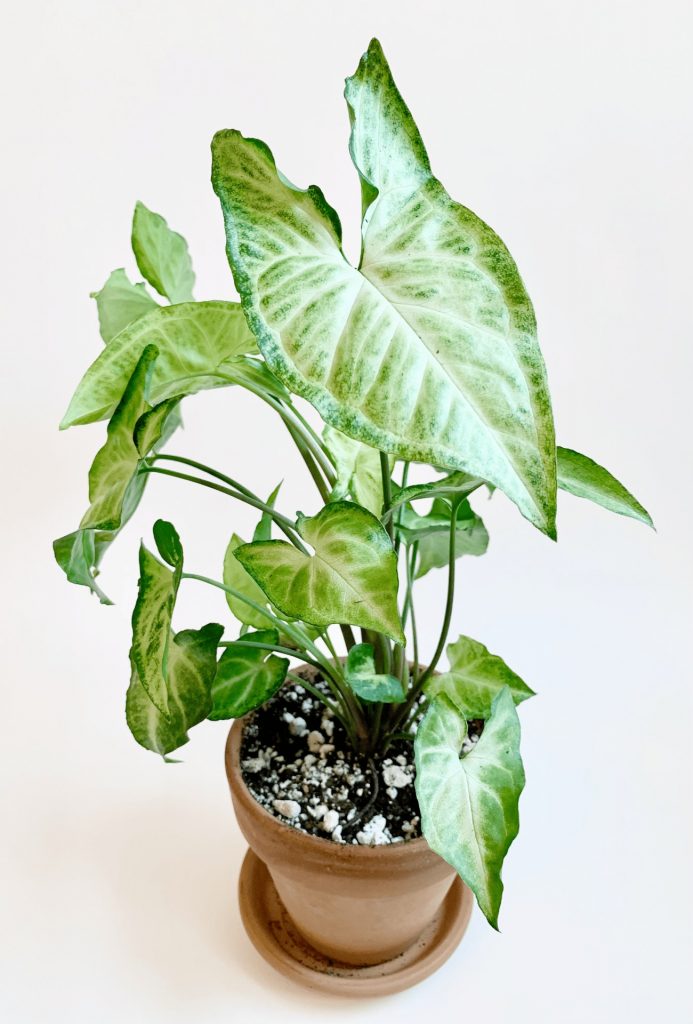
Syngoniums, also known as arrowhead plants or arrowhead vines, are vining plants with arrow-shaped, deep green to light green foliage. Arrowhead plants are native to Mexico, Central and South America, and the West Indies.
In this post, we’ll review arrowhead plant care and more! (If you’re looking for an arrowhead plant/syngonium propagation tutorial I recently moved that to its own dedicated post, so check it out at that link!)
Do arrowhead plants climb?
Yes, arrowhead plants are climbing vines, which is why they are also referred to as arrowhead vines.
Although this is not so obvious on younger plants, once these plants get to be about mid-size they will start to vine out. Like other vining plants, they use their aerial roots to climb.
If you’d like yours to climb, you can provide it with a moss pole. Allowing climbing plants to actually climb typically helps them grow stronger and larger.
Where can I buy an arrowhead plant?
You can easily find arrowhead plants on Etsy! Check out this gorgeous Syngonium variety!
And, you might try using the terms “arrowhead plant,” “arrowhead vine,” and “Syngonium” while searching for this plant since it goes by multiple names!
How much light does an arrowhead plant need?
These houseplants are great options for low-light homes, making arrowhead plant care super easy. While they do prefer bright to medium, indirect light in order to thrive to their full potential, they can grow in low-light conditions, too.
There are many varieties of arrowheads. Darker, greener varieties will need less sunlight while lighter, variegated varieties will need more.
If you are interested in a lighter variety of arrowhead but think you lack enough light, don’t worry! Grow lights are very beneficial in this case.
I use a few different sets of grow lights but these lights have been my absolute favorite for a while now. My plants absolutely love them, and the two adjustable gooseneck lights make them so convenient to use almost anywhere!
How often should I water my arrowhead plant?
How often you water this plant depends on your climate, with more frequent watering in hotter and sunnier climates.
This usually ends up being once or twice a week. A good rule of thumb is to water your arrowhead plant when you feel the top inch of the soil is dry.
Try not to let them dry out completely OR overwater them (which can put them at risk of root rot!). You may notice the leaves drooping when the plant gets a bit too dry.
Humidity
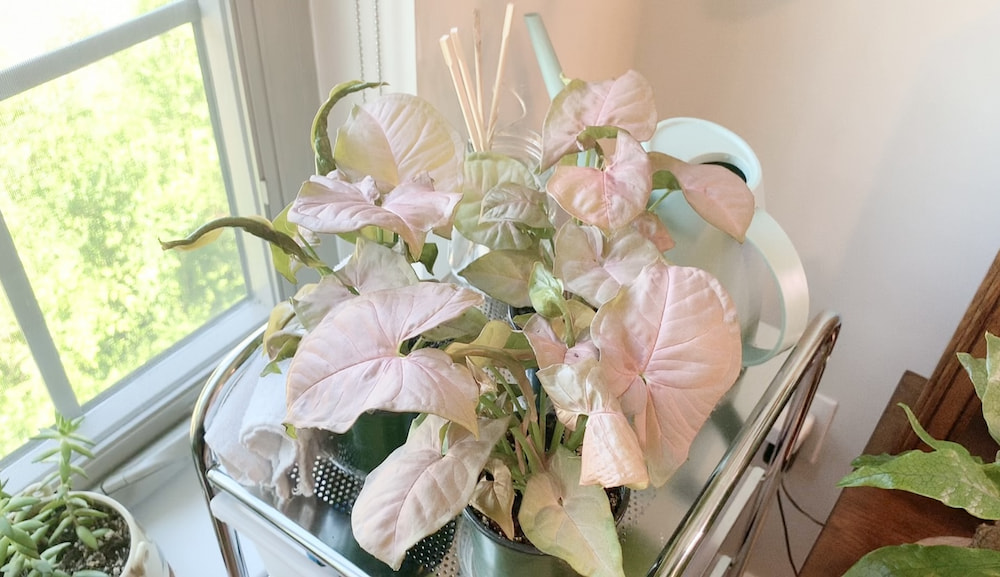
As the arrowhead plant is native to humid, tropical locations, it will really appreciate some extra humidity. You might also notice the leaves curling up if the humidity is extremely low.
Humidity becomes an especially important part of arrowhead plant care (and many other plants) in the dry winter or in the summer when the air conditioning is on.
There are a few ways to give your plants the extra humidity boost they need to thrive, but one of the easiest is using a humidifier.
Potting Mix
A well-draining potting mix that holds some moisture works best for arrowhead plants. A general indoor plant potting mix will be fine for this plant, as long as it has good drainage (which pre-made mixes generally do)!
Learn about growing syngonium cuttings in water instead of potting mix—a cool alternative!
Repotting
Arrowhead plants need to be repotted around every other year. They like to be somewhat rootbound, but not too much.
If you see roots coming out of the bottom of the pot then it’s definitely time to repot!
Repot your plant in a pot one size up and make sure it has drainage. It’s best to repot in the growing season (spring and summer), if possible.
Fertilizing
Another part of arrowhead plant care that makes it so easy is that they are fast growers and don’t necessarily need fertilizer.
However, if you’d like to give yours a boost, use a general houseplant fertilizer once a month during the growing season (spring and summer). I use this fertilizer for all my houseplants.

Are arrowhead plants poisonous to dogs and cats?
Yes, arrowhead plants are toxic to cats and dogs, so keep this houseplant far away from your furry friends!
How big do arrowhead plants get?
Since arrowhead plants are vines, they can grow next to continuously! This would happen in the wild, growing up a tree in its natural habitat. If given something to climb in your home, the vines can still grow several feet.
Even though the vines can grow very long, that doesn’t always mean you’ll have a nice full and bushy plant. See my post on how to keep syngoniums bushy for help growing a fuller plant!
Ready for your own arrowhead plant? Get one here!
Yolande says
Hi Julie! I have about 13 different kinds of syngoniums, all beautiful. They are my favorite!
I do have a question… can I train a syngonium to climb a moss pole if it does not have aerial roots?
Julie, Houseplant Expert says
Hi Yolande! The plant can’t climb without aerial roots, but you can always put a moss pole in the pot right away so that as soon as it gets big enough and grows aerial roots, it can start climbing!