
This post contains affiliate links. I will earn a small commission, at no extra cost to you, if you make a purchase through these links.
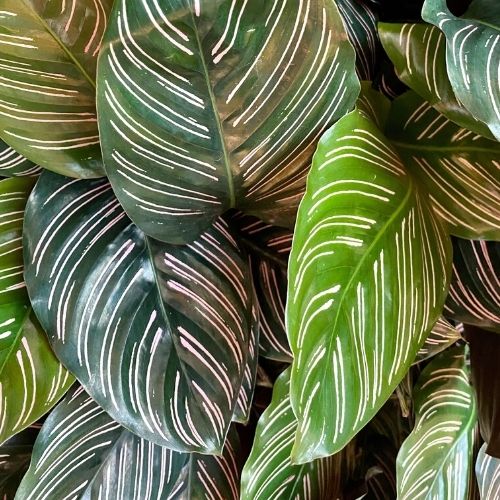
Calathea ornata, also known as pinstripe calathea or pinstripe plant, is one of many beautiful Calathea species. This one is known for its large, dark green leaves with pink pinstripes that look like they’ve been added on with a paintbrush. In this post, you’ll learn everything you need to know about Calathea ornata care and propagation.
Where can I buy a Calathea ornata?
You can easily find a Calathea ornata for sale on Etsy. Check out this beautiful Calathea ornata from one of my favorite Etsy shops!
How do you care for Calathea ornata?
Calatheas in general can be finicky when it comes to watering and humidity, and Calathea ornata is no different. This is the key to Calathea care. They like to remain moist and will do better with filtered, distilled, or rainwater instead of tap water, and they like humid environments, too. Read on for more details and a full care guide.
Light
Calathea ornata prefers bright, indirect light. It won’t be happy in low light, and don’t give it direct light, either.
Worried that you don’t have enough light? I used to allow this to limit my plant selection, but I will never do that again! Grow lights are such a huge help and my plants are very happy underneath them. Below are my two favorite grow lights:
For more light help, check out my post on grow lights for indoor plants as well as my guide to natural light for indoor plants.
How often should I water my Calathea ornata?
How often you water your Calathea ornata depends on your environment, with more watering needed in hot, sunny climates and less in cold, dark climates. Instead of worrying about watering on a schedule, you should water your plant when the top inch or so of the potting mix is dry.
Calathea ornata likes to remain moist but not wet. Try not to overwater it or you could put your plant at risk of root rot. To help prevent this, be sure you are always using your finger to feel down into the potting mix for moisture level first.
Calatheas are known to be finicky with water. If possible, it’s best to use rainwater, distilled water, or filtered water instead of tap water. (This goes for providing humidity, too!)
Humidity
Native to South America, Calathea ornata prefers a more humid environment. If the air is too dry you might get some crispy edges.
The easiest way to provide this is to use a humidifier for your plants—just set it and forget it! Below is one of my favorite plant humidifiers because it can last up to 96 hours.
Check out my post on the best humidifiers for plants for other humidifiers I recommend.
Temperature
Calathea ornata will be fine in normal household temperatures. As with all houseplants, they don’t like to be too cold. So basically, don’t place them next to a vent or on a cold windowsill.
Potting Mix
Since Calathea ornata like to remain moist, but not wet, they’ll need a potting mix that holds some moisture but is also well draining.
An indoor plant potting mix with some perlite, about a two-to-one ratio, will work fine, but I usually just eyeball it!
Fertilizing
You can fertilize this Calathea using an indoor plant fertilizer. Fertilize once a month during the growing season (spring and summer) and dilute it by half.
Repotting
Because they don’t like to become rootbound, repot your Calathea ornata every one to two years depending on how it’s growing.
You can confirm if a plant is rootbound by checking if roots are coming out of the drainage holes, checking for sad-looking or stunted growth, and slipping the plant out of its pot and checking if the roots are all heavily coiled around the outside of the soil.
Use a pot the next size up from its current pot that has good drainage. If possible, try to repot during the growing season (spring and summer).
Pruning
You don’t need to worry too much about pruning your Calathea ornata. Just remove any dead or dying leaves once they can be gently plucked away from the plant, or use a clean pair of scissors to cut them away if they can’t be pulled off.
If your Calathea has brown tips, you don’t have to remove the entire leaf. You can just trim off the damaged tips using a clean pair of scissors.
Foliage and Blooms
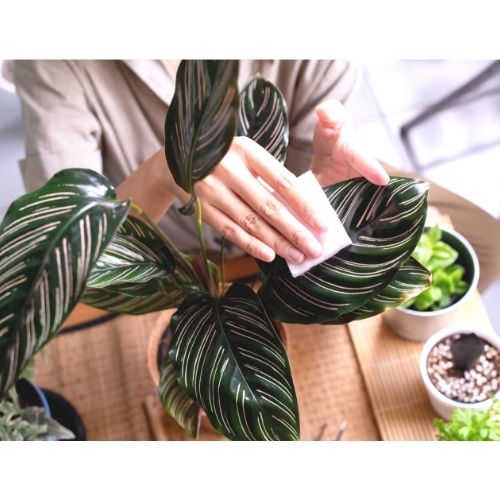
Calathea ornata has large, dark green leaves with pink stripes that look like they’ve been painted on with brush strokes. Plants with large leaves tend to collect dust, so every now and then wipe off the leaves with a damp cloth, supporting the underside of the leaf while you’re doing it.
A mature plant occasionally flowers a yellowish-orange-pinkish flower.
Why is my Calathea ornata plant dying?
If you’re experiencing problems with your Calathea ornata, it doesn’t always, or even usually, mean that it’s dying. It is probably suffering from one of a few common problems, which can usually be fixed.
Why are my Calathea ornata leaves curling?
Calathea ornata leaves curling usually means the plant is too dry, so give it a good, long drink! Be sure you are keeping the soil moist, but not wet, at all times.
Why does my Calathea ornata have brown, crispy edges?
This is most commonly caused by too dry air. Give your Calathea more humidity by using a humidifier or another method.
Why does my Calathea ornata have yellow leaves?
Yellow leaves can actually be caused by many things so be sure to evaluate your overall care routine. However, the most common cause is overwatering. Make sure you’re feeling the potting mix first before watering to determine if your plant actually needs water.
Pests
This plant is not super prone to pests, but you might deal with spider mites, mealybugs, and aphids. There are more in-depth methods of dealing with each specific best, but for general houseplant pest control, I like to use an insecticidal soap as well as Bonide Systemic Houseplant Insect Control.
How do you propagate Calathea ornata?
Unfortunately, Calathea ornata cannot be propagated through cuttings. Instead, it needs to be propagated by division. This means you are simply dividing two or more plants from one pot and repotting the separated parts.
Remove the plant from its pot and find one or more pieces to divide that each have their own separate root systems and each have at least one leaf.
Gently separate and untangled the roots from each other. If you need to, use a clean, sharp knife to cut the roots away, but try to keep as much intact as possible.
Pot up the separate pieces each into their own appropriately sized pots. Give them a good watering and continue to keep the soil moist, as you normally would for this plant.
Keep your new plant in the same light level as the original plant, as long as it’s not too bright. Help your newly divided plant along by providing it with high humidity.
Note that your plant might experience some shock, so give it some time to adjust. In a few weeks, it should start growing again.
Division is typically done while you’re repotting the plant.
Additional Information
Is Calathea ornata toxic to pets?
Calathea ornata is non-toxic to cats and dogs, but keep in mind it’s best practice to keep all plants out of your furry friends’ reach.
How fast does Calathea ornata grow?
Calatha Ornata is not a very fast grower. Under optimal conditions, it has a moderate growth rate. But it’s a lovely plant nonetheless!
Is Calathea ornata an indoor plant?
Calathea ornata is usually grown as an indoor plant, and makes a great one! Although it has a few quirks, its care is relatively simple. If you live in a tropical climate you might be able to grow it outdoors.
Are Calatheas and Marantas the same thing?
“Calathea” and “maranta” are sometimes used interchangeably, and sometimes the nickname “prayer plant” is used for calatheas. While they might look somewhat similar, Calatheas and Marantas are not the same plants.
“Prayer plant” is another name for marantas—not calatheas. Calatheas and marantas are in two separate genera, but they are both a part of the Marantaceae family.
More Calathea Posts

Leave a Reply