
This post contains affiliate links. I will earn a small commission, at no extra cost to you, if you make a purchase through these links.
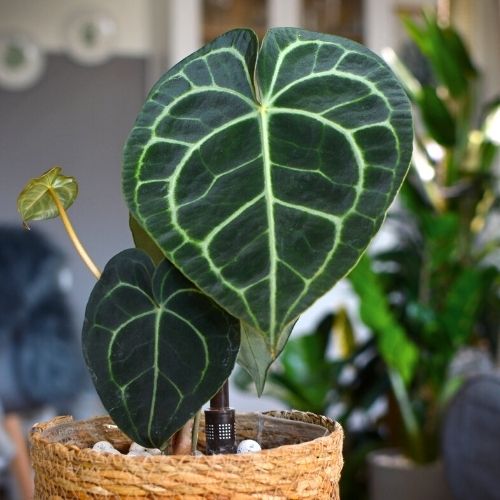
Anthurium clarinervium, also known as “velvet cardboard Anthurium” and sometimes as “giant laceleaf,” is an absolutely breathtaking houseplant known for its large, heart-shaped leaves that are unlike anything else. In this post, I’ll review everything you need to know about Anthurium clarinervium care and propagation.
Anthurium clarinervium are epiphytes, meaning they grow on the surface of another plant instead of out of the ground, and collect nutrients and moisture from the surrounding air, rain, and fallen debris. They are native to Mexico and are just one of nearly 1,000 species under the genus Anthurium.
Where can I buy an Anthurium clarinervium?
You can easily find an Anthurium clarinervium for sale on Etsy. Check out this gorgeous Anthurium clarinervium from one of my favorite Etsy sellers!
How do you look after Anthurium clarinervium?
Anthurium clarinervium, with its flashy foliage, may look like an intimidating plant, but its care is relatively simple. A few keys to taking care of this epiphyte are proper watering and a well-aerated potting mix. Read on for a full Anthurium clarinervium care guide.
Do Anthuriums like direct sunlight?
As with all Anthuriums, you should not place your Anthurium clarinervium in direct sunlight. Bright, indirect light or filtered light is best for this plant. It will do OK in some medium light, but not in low light.
If you don’t have enough light in your home to keep this plant happy, no worries! Grow lights are a great solution. I use grow lights for many of my plants. In fact, these are two favorite grow lights, which my plants absolutely love:
You can check out my post on grow lights for indoor plants for more grow light info. I also have a helpful guide to natural light for indoor plants.
Watering
Water your Anthurium clarinervium when the top inch or two of the potting mix is dry. Don’t let this plant dry out completely, but do your best not to overwater it or you could put it at risk of root rot.
Before watering, make sure you’re using your finger to feel down into the potting mix for moisture to determine if your plant actually needs to be watered.
Should I mist my Anthurium?
Anthurium clarinerviums are found in humid environments and therefore do well with higher humidity. Misting every day to every few days, depending on how dry the air is, is one way to do this.
Personally, I find other methods like using a humidifier to be more foolproof. Below is one of my favorite plant humidifiers because it can last up to 96 hours.
Check out my post on the best humidifiers for plants for more humidifier options.
Temperature
Try to keep your Anthurium clarinervium in between the high 60’s to mid 80’s degrees Fahrenheit (this is about 20 to 29.4 degrees Celsius). This might be normal household temperatures for some of us anyway!
Potting Mix
Anthurium clarinervium is an epiphyte and therefore does not need to be tightly packed in soil. Instead, they need a well-aerated, well-draining, loose potting mix. The potting mix also needs to hold some moisture since this plant doesn’t like to totally dry out.
A mixture I use for some of my epiphytes is about one-part orchid bark, to one-part perlite, to two-parts indoor plant potting mix—although I tend to just eyeball this!
Fertilizing
Fertilize your Anthurium clarinervium with a balanced houseplant fertilizer diluted to half-strength once a month during the growing season (spring and summer).
Repotting
This plant is not a very fast grower so you’ll only need to repot it every couple of years.
They don’t like to get too rootbound, so if you see roots coming out of the drainage holes, sad-looking or stunted growth, or if you see that the roots are all coiled heavily around the outside of the soil when you slip the plant out of its pot, then it’s definitely time to repot!
Use a pot the next size up that has good drainage, and if possible, try to repot during the growing season.
Pruning
You won’t need to do too much pruning with Anthurium clarinervium, but be sure to remove any dead or dying leaves. Use a pair of clean, sharp scissors to cut off the leaf at the base of the petiole.
Foliage and Blooms
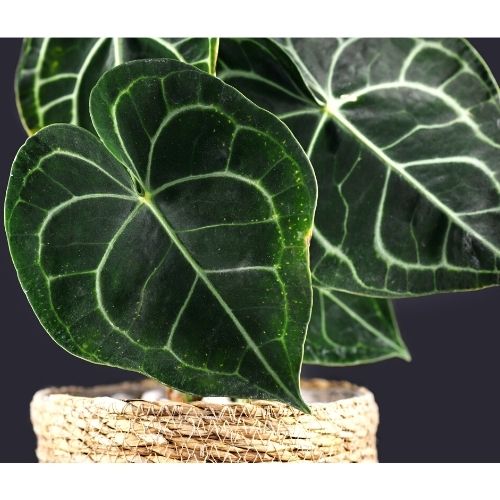
Anthurium clarinervium has large, heart-shaped, dark green leaves with striking light green veins. As a houseplant, the leaves typically grow to about eight to ten inches long, and of course, larger in the wild. The plant itself can get about three feet wide.
Plants with large leaves such as these tend to collect dust. Be sure to wipe away dust now and then using a damp cloth and support the underside of the leaf with your other hand while you’re doing that.
Mature Anthurium clarinerviums do sometimes bloom in the form of a spathe and spadix, but their blooms are not so nice to look at.
They also occasionally produce berries if the bloom is pollinated by another plant. These berries contain the plant’s seeds. Anthuriums are toxic, so don’t eat the berries. Just use them to grow more plants!
Problems and Pests
There can be many reasons why you’re experiencing a problem with your plant, so it’s important to evaluate your overall care routine. However, below are a few potential Anthurium clarinervium problems with their common causes.
- Brown, crispy leaf edges – Commonly caused by too dry a surrounding environment—try adding more humidity. More significant browning might be leaf scorch. Make sure your plant is not in direct sunlight.
- Yellow leaves – Commonly caused by overwatering—ease up on the watering!
- Pests – Pests are generally not a huge problem for Anthurium clarinervium but some pests you might run into include mealybugs, spider mites, scale, and thrips. There are more specific ways of dealing with each pest, but for general pest control, I like this insecticidal soap as well as Bonide Systemic Houseplant Insect Control. Be sure to read the instructions first and use caution around pets and kids.
How to Propagate Anthurium Clarinervium
Anthurium Clarinervium Propagation by Division
Although not very exciting, the easiest way to propagate Anthurium clarinervium is by simply dividing two or more plants growing in the pot that each have their own root systems. Make sure each piece has at least one leaf, but more is better, if possible.
Separate each part, being gentle and trying to keep as many roots as intact as possible. If you can’t separate a part, use a pair of clean, sharp scissors to cut the roots away from each other.
Pot up each newly divided plant into its own appropriately sized pot, and give them a good watering.
Division is usually done while you’re repotting the plant.
Anthurium Clarinervium Propagation by Cuttings
If your plant has some pups (baby plants) growing off the main stem, you can also propagate these.
Identity a pup that is a couple of inches long and has a leaf. Try to take a pup that also has some aerial roots attached to it. You’ll have a better success rate this way.
Use a clean, sharp knife and make your cut close to the base of the pup’s stem. Be very careful when doing this. You might have to work at it a little to cut it off and you don’t want to hurt yourself.
Let the cutting callus over for a day or so to help avoid infection. Then, place the cutting into moistened potting mix. Put it in bright, indirect light and keep the potting mix moist as the roots develop.
You can also put a clear plastic bag over the top of the cutting to help lock in beneficial humidity, but be sure to open this once a day to let in plenty of fresh air.
After a few weeks, you can give your cutting a very gentle tug to check for resistance. If you feel some resistance, that means a root system has developed and you can start to care for it like a normal plant.
Anthurium Clarinervium Propagation by Seeds
As mentioned earlier, if you have more than one plant, they may pollinate each other and you might end up with berries that contain seeds. You can use these seeds to grow new plants. The berries can take several months to a full year to develop and ripen, though.
This is, of course, the most difficult and time-consuming propagation method.
Additional Information
Is Anthurium clarinervium toxic to pets?
Yes, Anthurium clarinervium is toxic to pets so be sure to keep them out of your furry friends’ reach!
How fast does Anthurium clarinervium grow?
Although Anthurium clarinerviums can grow about three feet wide, they are not fast growers so you won’t have to worry about them taking up an entire corner so soon! They grow slow enough that they only need to be repotted every few years, although keeping them in optimal conditions will help them grow faster.
Is Anthurium a good indoor plant?
Yes, Anthuriums, including Anthurium clarinervium make great indoor plants for anyone looking for a statement-making houseplant. They are somewhat tricky to get the hang of at first but after understanding the basics, like proper watering and the ideal potting mix, their care is relatively low maintenance.
More Anthurium Posts

Leave a Reply