
This post contains affiliate links. I will earn a small commission, at no extra cost to you, if you make a purchase through these links.
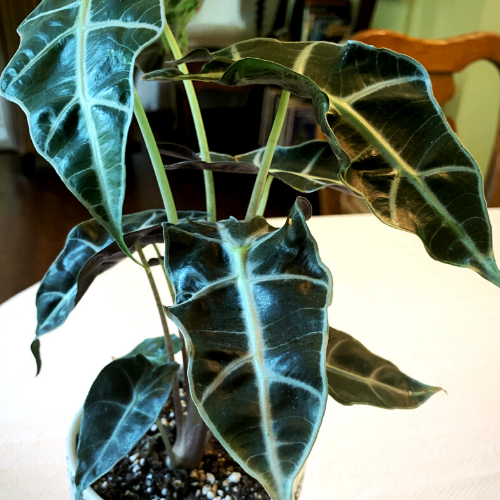
The Alocasia Amazonica can be easily recognized by its stunning dark green, long, heart-shaped leaves and whitish/light green veins. In the past few years, it’s become a lot more popular due to the unique and photogenic leaves. This plant goes by many names: Alocasia Polly (or Poly), Elephant Ear, Kris Plant, and African Mask Plant, to name a few.
Background
Why all the confusion over the name? Well, Alocasia Amazonica is actually a hybrid between two other Alocasias. You won’t find one of these in the wild unless it was introduced there by humans. The creator of this hybrid named the plant after his nursery, “Amazon Nursery.” In fact, Alocasias in general aren’t native to the Amazon at all, but rather to parts of Asia and Australia.
Sometime after this hybrid was created, a different garden center found this plant in their nursery and, because they originally thought it was a polypoid version of Alocasia Amazonica, they began calling it Alocasia Poly (which morphed into Polly). They later realized that it was just Alocasia Amazonica and not a different plant at all, but their new name stuck!
The other names, like “elephant ear,” are mainly due to the plant’s looks.
Where Can I Find an Alocasia Amazonica?
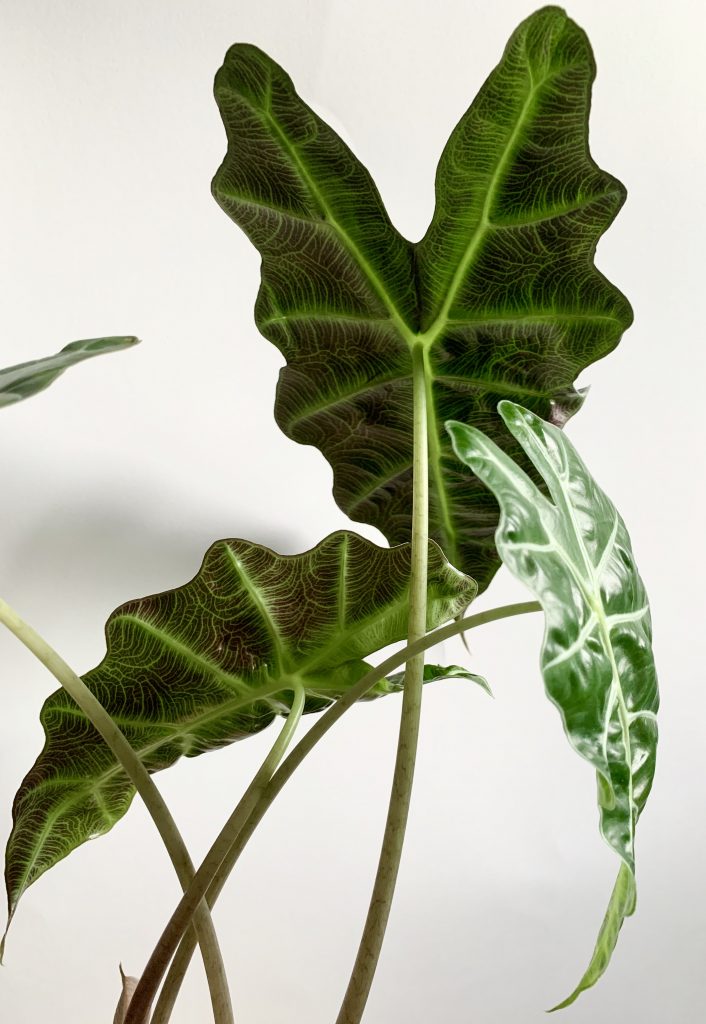
You can easily find an Alocasia Amazonica on Etsy. Check out this absolutely stunning Alocasia from one of my favorite Etsy sellers!
Caring for an Alocasia Amazonica
Don’t get me wrong, there is a learning curve, but once you understand this plant’s specific needs it’s pretty low maintenance! The best part? It doesn’t look low maintenance at all because it’s so unique.
Soil
This plant likes to stay moist—not WET, but MOIST—so be sure that you add some drainage to your potting medium. A good guideline for your medium is one part soil, one part peat, and one part drainage, like perlite.
Light
This plant prefers bright, indirect light but can also tolerate medium indirect light. Check out my guide to natural light for indoor plants for help figuring out the light in your home.
If you don’t think you have enough light, grow lights can be a real lifesaver! For more help, check out my easy guide to grow lights for indoor plants.
Since the leaves are so big and showy, it becomes noticeably lopsided if you leave one side growing towards the light for too long. In general, it’s good to rotate your plants. You’ll definitely want to make sure to rotate this one.

Water
I repeat—this plant likes to be moist, not wet. When the top inch of the soil is dry, water it so it’s evenly moist. Don’t let it completely dry out, but don’t keep it too wet either or you could be at risk of root rot.
Humidity
Alocasia Amazonica also likes humidity. There are many easy ways to create humidity for your houseplants, with using a humidifier being one of the easiest! My guide to creating humidity houseplants will explain, step-by-step, different methods.
Repotting
You should repot this plant every year or two when it becomes rootbound or outgrows its pot. Choose a pot that’s the next size up from its current pot and has drainage.
Pruning
You shouldn’t need to prune your plant except to remove any dead or dying leaves, which will happen now and then as new leaves grow in. It’s best to wait until the dying leaf is at the point when it can be gently plucked away from the plant, not forcibly pulled off.
Fertilizer
These plants are heavy feeders and like to be fertilized. Use a balanced, water-soluble houseplant fertilizer during the spring and summer (the growing season), every two to four weeks.
Alocasia Amazonica Propagation
Alocasia Amazonica can be propagated by division or by digging up the corms and replanting them. (You may see corms referred to as bulbs even though they are slightly different—I was mistakenly calling them bulbs for a while, too!)
Division
To divide two already-growing plants, remove the plant from its pot and gently separate the roots of each. If you cannot separate them with your hands, use a clean, sharp knife to cut them away from each other, keeping as much of the roots intact as possible.
Plant the separate plant into an appropriately sized pot with good drainage, water it, and care for it as you normally would.
Corms
To replant the corms, remove the plant from its pot and look for them around the roots. Snip them away from the main root of the plant using clean scissors, snipping close to the corm and leaving most of the root attached to the main plant.
Place the corm into a small container with a small amount of water so the bottom is sitting in water but the top is above water.
You can also keep them in moist potting mix, but from experience and what I’ve heard from others, you’ll have better success in water. (Thanks to my Instagram friend @lizziesjungle who originally suggested to me using water instead of potting mix.)
Keep the humidity high and the light bright and indirect. In a few weeks you should see some roots growing out of the sides and a new little sprout on the top. Once you have a little plant growing, you can pot up your new plant, water it, and start caring for it as you normally would.
Usually, the plant has to be a few years old to have developed many corms. These will be clustered around the roots and might even push up through the soil’s surface.
Note that it’s best to propagate in the spring or summer. Division or digging up corms is usually done while repotting the plant to minimize stress on the plant
Is Alocasia Amazonica toxic to pets?
Yes, these plants are toxic to our furry friends, so be sure to keep them out of their reach!
More Alocasia Posts
Sophia. says
Why and what does the shoots do when they sometimes grow out from the plant, with the white stigma instead of a leaf? Can you use these shoots for propagation?
Kristine Perry says
Hi there,
Just wondering what the best fertilizer is to use for these plants. Can you please provide an example? Thank you!
Julie, Houseplant Expert says
Hi Kristine – An example would be a great idea, right?! ? (Duh, Julie!). I like this fertilizer, I use it for all my plants: https://www.amazon.com/gp/product/B00BIO560G/ref=ppx_yo_dt_b_search_asin_title?ie=UTF8&psc=1