
This post contains affiliate links. I will earn a small commission, at no extra cost to you, if you make a purchase through these links.
The ZZ plant, short for Zamioculcas zamiifolia and nicknamed the Zanzibar Gem, is the perfect low-maintenance and low-light plant. In this post, l’ll review how easy ZZ plant care and propagation both are!
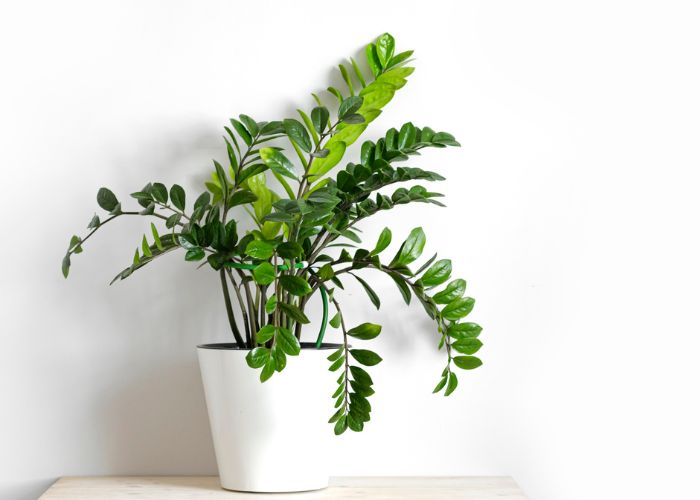
The ZZ plant is native to parts of Africa. While they’re slow growing, they’re incredibly easy to care for. After enough time, they can grow from being a couple of little stems to two to three feet tall and incredibly full. A key part of successful ZZ plant care is understanding they have rhizomes, which produce new plants and also store water and nutrients. Therefore, ZZ plants can go long periods without being watered. We’ll discuss this more in the sections below.
Where can I buy a ZZ plant?
You can easily find a ZZ plant to buy on Etsy! Check out this nice, full ZZ plant from one of my favorite Etsy shops.
ZZ Plant Care
Does the ZZ plant need sunlight?
Technically, no, the ZZ plant does not need SUNlight. It can survive under artificial light, which is why you often find this plant in office buildings and malls! ZZ plants prefer bright, indirect light but are known to be very tolerant of low light, which is part of what makes their care so easy! More light will help the plant grow faster, but don’t put it in direct light as it can scorch the leaves. Check out my favorite grow lights to ensure your ZZ has optimal growing conditions.
How often should you water a ZZ plant?
ZZ plants like to completely dry out between waterings—how often that is depends on light level and other factors that contribute to drying out. They store water in their rhizomes and can go a long time without being watered. For this reason, they are perfect for those who travel a lot or have a tendency to forget about watering their plants! For more help on how to know when to water your houseplants, check out this post.
Humidity
Being native to tropical areas of Africa, some extra humidity will do the ZZ plant well; however, humidity levels aren’t a deal breaker since this plant is so low maintenance.
Potting Mix
ZZ plants are easy to please and will be fine with a well-draining indoor plant potting mix. I like to add an additional handful or two of perlite into my potting mix for extra drainage if I have it around.
Fertilizing
ZZ plants aren’t heavy feeders and don’t necessarily NEED fertilizer. However, if you’d like, you can use a general houseplant fertilizer once a month during the growing season (the spring and summer). Overfertilizing can burn the plant and cause damage, so you don’t fertilize it too often.
Repotting
As a general guideline, you’ll need to repot ZZs every other year to every few years. It’s a slow grower, but exactly how often you repot it will depend on how fast it’s growing in your environment. Once you notice it’s gotten rootbound or looks like it’s outgrowing its pot, then you can repot it. Repot your plant in a pot one size up, and make sure it has a drainage hole. It’s best to do your repotting in the spring or summer if you can wait.
Pruning
You can prune ZZ plants to control their size and shape. Find a node around where you want to encourage new growth. Nodes are the growth points along the stems, so anywhere a leaf is growing. Cut just above that node with clean scissors. That will trigger the node (a growth point) to push out new growth. Remember, ZZs are slow growers, so this could take a while.

Propagating a ZZ Plant
Division
The easiest and quickest way to propagate the ZZ plant is through division of the rhizomes, which you’ll probably have to do at some point anyway once the plant gets too large. A rhizome is a modified part of the stem that grows underground on certain plants. They store water and nutrients and produce new plants. (Note that ZZ plants need to be at least a few years old to have several rhizomes.)
To propagate your ZZ plant, wait until it’s mostly dry. Then, remove the plant from its pot to find where each separate plant is attached to a rhizome. Separate the plants, gently untangling any roots and if necessary, using a pair of clean shears or a knife to separate any tangled roots. Try to keep as many roots intact as possible.
If the rhizomes themselves are stuck together, use a clean, sharp knife or shears to make a clean cut to separate them. If you end up needing to do that, cure the plant by letting it sit out for a few hours before planting it.
Pot the separated plants into a pot with good drainage. You can plant them in separate, smaller pots or all together in one larger pot. Once you’ve potted up your plants, water them and care for them as you normally would.
Stem Cuttings
You can also propagate ZZ plants by taking stem cuttings—either an entire stem or just a small portion—and rooting them in water. It can take many weeks to months, even, to develop roots this way. I would not go this route unless you like the look of ZZ plant stems in a vase of water and you don’t mind having that around for a long time.
Additional Information
Is the ZZ plant toxic to cats and dogs?
Yes, the ZZ plant is toxic to cats and dogs, so be sure to keep this plant out of your furry friends’ reach!
Leave a Reply