
This post contains affiliate links. I will earn a small commission, at no extra cost to you, if you make a purchase through these links.
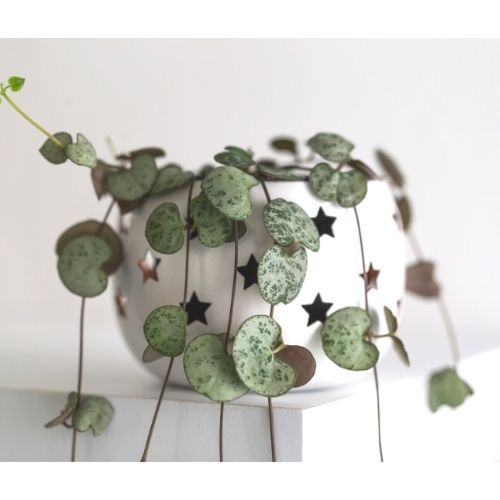
String of hearts, also commonly known as chain of hearts, rosary vine, hearts on a string, and Ceropegia woodii (its scientific name), is an easy-to-grow trailing vine that is loved by many in the houseplant community. In this post, I’ll review string of hearts care as well as how to propagate string of hearts.
String of hearts is native to parts of Southern Africa. This plant is actually a semi-succulent plant and stores moisture in its leaves.
Although string of hearts is pretty easy to care for, understanding that they are semi-succulent is the key to success with this plant, as I’ll explain in the sections below.
Where can I buy a string of hearts?
You can easily buy a string of hearts on Etsy! Check out this gorgeous, full string of hearts from one of my favorite Etsy sellers.
Why is my string of hearts dying?
Now that we know this plant is semi-succulent, we can put two and two together—the most common ways to kill succulents is by overwatering them and not giving them enough light!
These are two of the most likely reasons why your string of hearts is dying, and we’ll review those two aspects of string of hearts care in the next few sections.
String of Hearts Care
How much sun does string of hearts need?
Bright, indirect light is best for the string of hearts plant. Direct light will burn the leaves. Make sure to provide light to the top of the plant, too, to keep it from going “bald!”
Check out my guide to natural light for indoor plants for help with determining what kind of light you have in your home. I also wrote a post all about grow lights for plants for those of us who live in low-light homes (like me!).
Watering
Since this plant stores water in its leaves, it will be happiest when allowed to dry out between waterings. Be sure to use your finger to feel down into the soil for moisture before watering it.
And, because this plant likes to remain on the dry side, it’s at a higher risk of root rot, so take care to not overwater it!
Note that when the plant is too dry, the leaves may start to look a bit shriveled or dried out.

Does string of hearts like humidity?
Nope! Because this plant is semi-succulent and prefers to be on the drier side, it doesn’t require any additional humidity to thrive.
Potting Mix
Since the string of hearts plant likes to be dry, it needs a very well-draining potting mix. It’s important the potting mix doesn’t get compacted, which will prevent it from draining adequately.
You can use a cacti/succulent potting mix for this. You can buy this mix or make it yourself with one-part regular indoor plant potting mix, one-part perlite, and one-part coarse sand.
Fertilizing
Use a balanced indoor plant fertilizer once a month during the growing season. They don’t need much fertilizer, so be careful not to overfertilize them which will just end up hurting the plant and its delicate roots.
Repotting
The string of hearts plant is OK with being slightly rootbound, therefore, it can be repotted every few years as long as the plant appears to still be growing well in its current pot.
And, since the string of hearts doesn’t really spread out but mostly just grows longer, “repotting” could just mean replacing the potting mix but still using the same-size pot.
When repotting, use a pot that’s the next size up from its current pot (if needed) and has drainage. And always remember it’s best to repot in the spring or summer (the growing season) if possible.
Pruning
This plant doesn’t require much pruning, but you can give any vines that are growing leggy or too long for your liking a “haircut.” To do this, use a pair of clean, sharp scissors to snip the vines to your desired length. (Remember, save them for propagation! We’ll review that in the next section.)
Aside from an occasional haircut, remove any dead or dying leaves once they can be gently plucked away from the plant.

How Do You Propagate String of Hearts?
Propagating string of hearts is really easy and one of the reasons that makes this plant such a favorite among houseplant enthusiasts. We’ll review the easiest ways to propagate string of hearts below.
Propagate string of hearts in water
To propagate string of hearts in water, use a pair of clean, sharp scissors to snip off some sections you’d like to propagate.
Stick the ends of the vines into a jar of water, removing any hearts that are under the water, and put the jar in a location with bright, indirect light. Be sure to change the water when it gets murky or slimy, about every few days to a week, and fill the water back up when it gets lower.
Once the roots are a few inches long, which will take a couple of weeks, you can transfer the cuttings into potting mix and care for the plant how you normally would.
Propagate string of hearts in potting mix
Propagating string of hearts in potting mix is also very easy. Snip off one or a few vines and gently remove some of the hearts to expose more of the nodes and encourage rooting and growth.
It’s even better (but not necessary) if the vines have tubers on them! Tubers are the little white balls (not the leaves) that grow along a vine.
Lay the vine down on top of the potting mix. You can position the vine in somewhat of a coil so that it fits in the pot, or you can snip it into sections. Make sure the nodes/tubers are nicely nestled into the potting mix, but you don’t have to totally bury them.
Place in bright, indirect light and mist the potting mix as needed to keep it moist. Roots will sprout from the nodes/tubers, and you want to keep the mix moist as the roots are sprouting and developing.
After a few weeks, your plant should have at least a small root system developed. If you’d like, you can test the plant by giving it a VERY gentle tug to check for resistance. If there is resistance, the roots have developed. Now, you can care for the plant how you normally would!
Additional Information
Does string of hearts grow fast?
Under the right conditions, yes, string of hearts can grow fast. Remember, because they are semi-succulent, you’ll really need to pay attention to their light and watering.
If you get these two factors right then your string of hearts should be pretty happy and grow well. As an indoor plant, they typically grow to be one foot to a couple of feet long.
Is the string of hearts plant toxic to pets?
String of hearts is non-toxic to cats and dogs, but keep in mind that it’s best practice to keep all plants out of your furry friends’ reach regardless.
(If you love string of hearts then you’ll love string of pearls and string of turtles! Check out my string of pearls care and propagation guide here and my string of turtles care and propagation guide here!)
winston black says
THIS WAS VERY INFORMATIVE.
Kathy says
My string of hearts has loads of white balls and is about 3ft long’. It’s very thick like a fishing net. I. Couldn’t separate the strings What should I do to help this plant.k
Julie, Houseplant Expert says
Hi Kathy – Are you concerned about the white balls? Those are aerial tubers, and they are a good sign that your plant is happy!