
This post may contain affiliate links. I will earn a small commission, at no extra cost to you, if you make a purchase through these links.
As a houseplant owner, you’ve probably heard of bottom watering plants at some point and wondered if it’s something you should do. In this post, I’m going to review everything you need to know about bottom watering plants.
What is bottom watering?
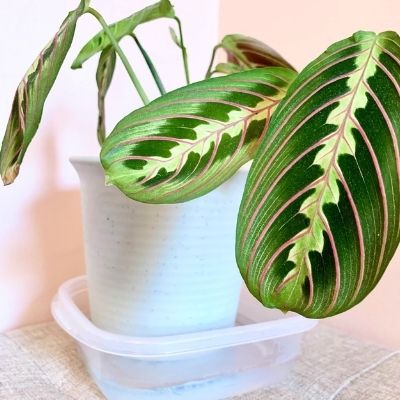
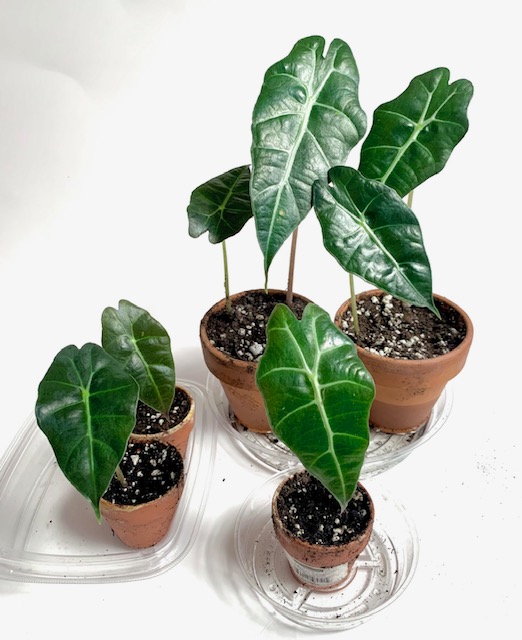
Bottom watering plants is exactly what it sounds like! It means to water your plants from the bottom by allowing them to sit in a container of water for a period of time and soak up the water.
Meanwhile, top watering is watering from the top using a watering can, faucet, etc.
Bottom watering is very effective and can be one of the best ways to water plants, although completely replacing top watering with bottom watering isn’t usually recommended (you’ll learn why further down in this post).
That said, using bottom watering as an additional method can be beneficial.
How to bottom water your plants
- First, in order for this to work, your pot must have a drainage hole so your plant can actually suck up the water. Make sure your plant’s soil is not compacted, otherwise, it will have trouble soaking up the water.
- Find a bowl or container large enough for your plant to sit in. Fill it up a few inches to halfway with water, depending on the size of your plant (bigger plant = more water!). Put your plant in the water.
- Check the plant after about ten minutes to see how much water the plant has sucked up.
- If the plant has soaked up all the water very quickly, it was thirsty! Add more water and let it soak up more.
- Ten minutes won’t be enough time for all plants, so if it didn’t soak up any water during that time, no biggie! Let it sit for 20-30 minutes, then check the water line on the pot to see if it moved lower at all.
- If it did (even just a little), your plant likely needs more time to continue soaking up the water. If it didn’t budge at all, your plant may not have needed water like you thought it did.
- Get rid of the excess water in the tray when you’re done. Do not pour it back into your plant. If your plant hasn’t soaked it up, then it doesn’t need it. Letting it soak unnecessarily can lead to overwatering and root rot.
Note: If you bottom water your plants most of the time, periodically top water them to flush out any salt and mineral build up, once a month or so. Salt and mineral build up is a problem you need to watch out for with bottom watering.
Is it good to water plants from the bottom?
For most plants, bottom watering is beneficial.
Pros of bottom watering plants include:
- Plants have more control over their water intake because we’re allowing them to soak up what they need, rather than us sometimes aimlessly pouring water into the top of the soil.
- You won’t be accidentally pouring water over the leaves, which can lead to water sitting in leaf/stem crevices causing rot. Some plants are extra sensitive to this.
- Bottom watering waters plants more evenly.
- It effectively gives super-dry plants a healthy drink.
- Roots get stronger as they grow down towards the water source.
- It reduces your chances of overwatering (it’s still possible though).
- It can reduce the chances of attracting pests if the soil’s surface is not sopping wet.
- Personally, I wouldn’t say the risk goes down THAT much, but if you have a problem with attracting pests, try switching to bottom watering for a little and see what happens.

Cons of bottom watering plants include:
- It doesn’t flush out excess salt and minerals like top watering does. You need to top water your plants in order to flush them out, once a month or so, but some plants are extra sensitive to this. Research if your plant is sensitive to salt or minerals. If it is, you might want to avoid bottom watering altogether.
- It takes longer. To be honest, this is the number-one reason why I don’t bottom water my plants that often.
- Depending on your tendency to forget things, you’ll need to set a timer to remember to check on your plants. This is my number-two reason why I don’t bottom water my plants that often!
Can you bottom water all plants?
Yes, the mechanism is the same. Plants will soak up the water through the bottom of the pot just as long as there is a drainage hole and the soil is not too compacted.
However, as I mentioned above, there are some plants that won’t do well with bottom watering because they are extra sensitive to salt and mineral build up. Make sure to check if your plant is one of them.
Meanwhile, some plants will LOVE bottom watering because they are extremely sensitive to getting their foliage wet. African violets are notorious for this and bottom watering is a standard watering method for them.
You will still need to (carefully) flush them out periodically, though.
How long should I bottom water my plants?
Exactly how long you let your plants sit in water depends on their size and how dry they are. Smaller plants will be done faster. Always check your plants’ soil after about 10-20 minutes to gauge the situation.
But instead of going by a specific length of time, you should be keeping an eye on the water level and whether or not it’s gone down. See my “How to bottom water your plants” step-by-step instructions earlier in this post!
Whatever you do, do not leave plants in the water permanently. Set a timer if you need to so you won’t forget about them.
Can you over water by bottom watering?
Yes, if the plant is sitting in water too long, you can still overwater your plant through bottom watering. However, bottom watering is a more controlled method of watering your plants. By remembering to check your plant every ten minutes or so while it’s sitting in water, you can significantly reduce your chances of overwatering and causing root rot.
bettym says
nice article!
you are right, bottom watering is better overall, but i’m finding new transplants do better from top watering. i planted 2 trays of tomatoes and used both watering methods, one for each.
transplanted both trays last week, the top watered tray plants are bigger today but i spent more time checking progress (drier)
Julie - Houseplant Aficionado says
Very interesting, thanks for sharing your experience, Betty! And glad you liked the article!
Shelby says
I have been bottom watering my plants for a bit now and I have some luck but I am also still having issues with overwatering. I don’t really understand how to know when my plants are watered “enough”. Any suggestions?
Julie - Houseplant Aficionado says
Hi Shelby – I usually check after about 10 minutes and then I feel if the moisture is just under the soil’s surface. If it’s still pretty dry, I keep it soaking and check it in another few minutes. Other than that, I would just observe how your plants react afterwards and whether they look under or overwatered or happy!
Carrie says
I use a moisture meter for my plants and I love it! (Amazon, $12) I’m new to plants so it’s helping to take some of the guesswork out of it until I’ve gained some experience and knowledge.
orlando says
i had problem with to dry soil but still its a good composed soil so I resolved it by applyingvery slow irrigation on each plant so after 10 min I checked soil down deep it was wet. that’s how I fix the problem
Tyrone says
I’ve tried this technique with my succulents and some of my houseplants at home and it works. Although you’re right as well, it doesn’t work the same with other plants so it’s important to be extra careful and know the pros and cons of this method; and check and observe the plants’ roots and leaves regularly especially after watering them to avoid any trouble.
Marilyn says
I need advice a.s.a.p. I am repotting several Christmas Cactus. The new pots only have one hole…my old pots had several holes. I prefer watering from the bottom. Will just the one hole work? Thanks!
Julie, Houseplant Expert says
Hi Marilyn – While one hole probably won’t work as well as many holes, it should still work, especially if those pots are terra cotta and therefore porous.
K says
Great article ! So helpful, thank you ! ?❤️
LivingStone says
I began watering my rubber tree plant and corn plant that sit in 5 gallon and 10 gallon containers respectively, from the bottom and they have been growing fantastically for a couple of years now. its like they grow crazy everytime I water them from the bottom about twice a month. Maybe its the structured water, that comes from my 5 gallon refill bottles. I buy water locally in the grocery store that has been through reverse osmosis. Each 5 gallon container takes its turn sitting in a pouring stand that rests above on top of a large Tesla Purple Plate that rests underneath on the floor. Its known the purple plates restructure water properly permanently emitting raw cosmic energy as it comes from the universe, said to be very healthy and very healing for all life forms. I just bought some giant sequoia and bristle cone pine tree seedlings in an experiemnt to see if i can grow them where I live. The baby seedlings are going crazy after being transplanted in small 1/2 gallon size potting soil containers that have been bottom soaked in the restructured water. I have never found top watering to be more beneficial as compared to bottom watering.
LivingStone says
I began watering my rubber tree plant and corn plant that sit in 5 gallon and 10 gallon containers respectively, from the bottom and they have been growing fantastically for a couple of years now. its like they grow crazy everytime I water them from the bottom about twice a month. Maybe its the structured water, that comes from my 5 gallon refill bottles. I buy water locally in the grocery store that has been through reverse osmosis. Each 5 gallon container takes its turn sitting in a pouring stand that rests above on top of a large Tesla Purple Plate that rests underneath on the floor. Its known the purple plates restructure water properly permanently emitting raw cosmic energy as it comes from the universe, said to be very healthy and very healing for all life forms. I just bought some giant sequoia and bristle cone pine tree seedlings in an experiemnt to see if i can grow them where I live. The baby seedlings are going crazy after being transplanted in small 1/2 gallon size potting soil containers that have been bottom soaked in the restructured water. I have never found top watering to be more beneficial as compared to bottom watering.
Chico says
CHICAAAAAAAA, good article. I shall bottom water me string o pearls tonight
Virginia says
I received a kalanchoe beharensis as a gift. It’s a young plant in a 6” Terra cotta pot, and I think it’s in regular potting soil. It has fuzzy leaves so I figured bottom watering would be good, but I cannot get it to take up water from the bottom. I left it for forty minutes in four inches of water and it remained dry. Should I give it longer? Could the soil be hydrophobic? It doesn’t seem compacted.