
This post contains affiliate links. I will earn a small commission, at no extra cost to you, if you make a purchase through these links.
Terrariums. They’re so beautiful yet so intimidating—but they don’t have to be! In this post, I’ll show you 10 closed terrarium plants that are so easy you can almost “set it and forget it” when it comes to your terrarium care.
The Quick List of Closed Terrarium Plants
Before we fully dive in, here’s a quick list of 10 of the best closed terrarium plants. We’ll review these all more in depth further down.
- Carnivorous Plants
- Nerve Plant
- Lemon Button Fern
- Moss
- Baby Tears
- Syngonium
- Aluminum Plant
- Pothos
- Maidenhair Fern
- Mini Orchids
What are the best plants for a closed terrarium?
The best closed terrarium plants have a few key requirements. Closed terrarium plants love warm, moist, and humid environments.
They are plants that will actually fit in the container you’re using, or ideally, they’re slow growing so you don’t have to constantly prune them.
You should also consider having plants with similar lighting requirements if you’ll be planting more than one species in the same terrarium.
Can you put any plant in a terrarium?
As long as they will fit, most plants can go in a terrarium—the important distinction is whether you’re using an OPEN or CLOSED terrarium.
If your plant does not love moisture and humidity, it does NOT belong in a closed terrarium and you should use an open terrarium instead. We’ll review the difference between the two below.
What is the difference between closed and open terrariums?
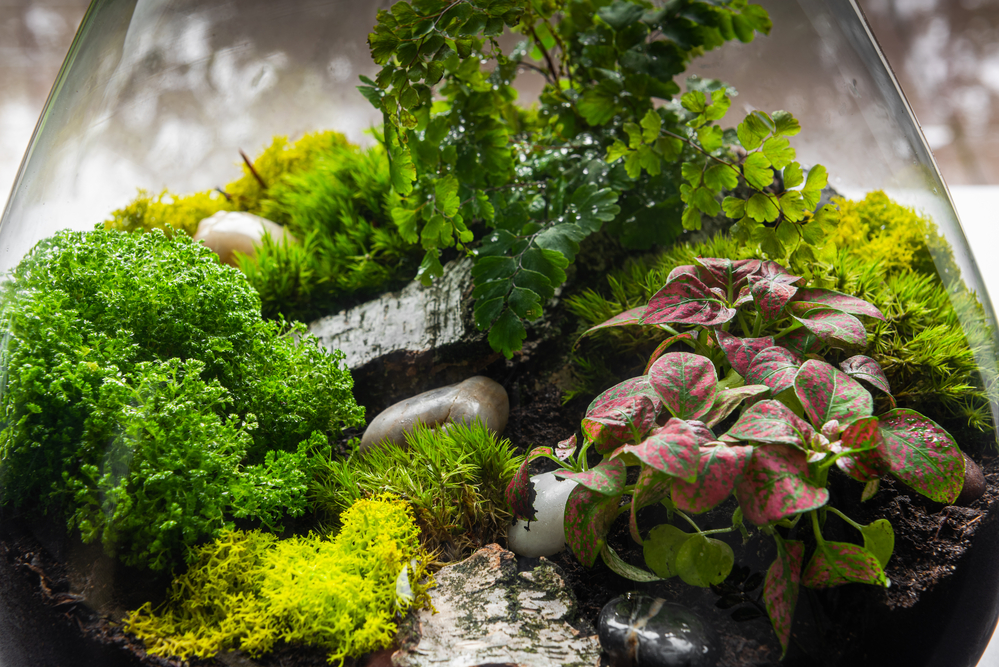
If you’re new to terrariums, you might not think closed and open terrariums are too different. But they are actually extremely different, and it’s important to understand that. Closed terrariums are their own ecosystem.
They actually have their own mini water cycle. This is why they don’t need to be watered often and require very little care overall.
Open terrariums are sort of like another container to put your plant in. It is an open glass container, so it doesn’t have any kind of water cycle or self-sustaining qualities.
You do still need to make sure your open terrarium has good drainage, though.
10 of the Best Closed Terrarium Plants
All of these plants love moisture, but remember, “moist” does not mean sopping wet!
1. Carnivorous Plants

These make great terrarium plants as most carnivorous plants love to be constantly moist and appreciate full sun. Many are native to bog-like environments, so it makes sense!
2. Nerve Plant
Nerve plants appreciate bright, indirect light, as well as maintaining consistent soil moisture.
3. Lemon Button Fern
Ferns are excellent candidates for terrariums. They love bright to medium, indirect light, and staying constantly moist. Ferns are also popular plants for the bathroom for this reason!
4. Moss
Mosses are very popular for terrariums because they are extremely useful in designing mini landscapes. Mist your moss to maintain constant moisture but make sure it’s not sopping wet.
Provide it with bright to medium, indirect light. Note that there are many different kinds of moss but most do prefer a warm, humid environment.
Supplies mentioned in the video:
- Moss
- Perlite
- Charcoal
- Potting mix
- Filtered water
- Container (plant mister terrarium)
- Container (larger terrarium)
5. Baby Tears
And speaking of designing mini landscapes, baby tears is another plant that works well as a ground cover. Provide your baby tears with bright to medium, indirect light. Keep the potting mix consistently moist.
6. Syngonium
Keep your syngonium in bright to medium, indirect light, although darker varieties can tolerate some low light. Syngoniums do not like to dry out, so keep the potting mix moist.
7. Aluminum Plant
Aluminum plants appreciate bright, indirect light. And yep, you guessed it—keep the potting mix moist!
8. Pothos
Pothos prefer bright to medium, indirect light although they can tolerate some lower light.
I’ve found that people feel differently about how moist or dry to keep pothos, but I’ve always found that these plants do well when the top inch or so of the potting mix has dried out, meaning the mix always stays somewhat moist below the surface.
9. Maidenhair Fern
Maidenhair ferns make a lovely, delicate addition to a terrarium. Give your maidenhair fern bright, indirect light and keep it evenly moist.
10. Mini Orchids
Keep your mini orchid in medium to bright, indirect light. Water your orchid when the medium it’s growing in is dry.
For this reason, orchids might do better in a single-plant terrarium or planted along with other orchids, instead of with other plants that like to remain constantly moist.
However, orchids do like humidity which is why they still make great terrarium plants.
Some of these plants are on the larger side and some are on the smaller side. Choose whatever fits your needs, or go crazy and put lots of small plants in a larger terrarium!
This is part of considering the overall design of your terrarium—choose plants that match the vibe you want.
Perhaps you want to have a single plant as a real statement-making piece. Or maybe you want something that looks more lifelike, like a tiny terrarium world!
How Long Do Closed Terrariums Last?
If a terrarium has multiple healthy plants producing new growth and is well taken care of, it can technically last forever.
Remember, a closed terrarium is an ecosystem and can mostly sustain itself aside from occasional watering needed. However, if you have a single-plant terrarium and the plant dies, well, that’s that.
What Do I Need for a Closed Terrarium?
Supplies you need for a closed terrarium include:
- A clear glass container that has space to plant in and preferably has a lid you can easily remove
- Drainage layers, like pebbles and perlite
- Horticultural charcoal
- Indoor plant potting mix
- Your plant(s)
You can read my DIY closed terrarium post here!
Can You Put Air Plants in a Closed Terrarium?
While air plants like some humidity, you shouldn’t put them in a closed terrarium because they do like to have fresh air and good air flow. However, they make excellent, beautiful plants for open terrariums!
Do Terrarium Plants Need Water?
Yes, you still need to water your closed terrarium plants, but not nearly as much as open terrarium plants or plants in regular pots.
Every other week or so, check the soil for dampness to determine if watering is needed. Also, if there’s no condensation on the glass, then your terrarium is probably too dry.
You only need to use a small amount of water, so water a little at a time and if you see it draining through to the bottom, you’ve used too much. Try not to get the water all over your plant’s foliage.
Terrarium Care
Put the lid on the terrarium and place it in an appropriate light level for the plant that’s inside. Never put your terrarium in direct light. The glass will magnify the light and roast the plant.
As mentioned in the above section, you will not need to water your closed terrarium often. Every other week or so, check to make sure the soil is still moist or if there’s still condensation on the glass. If not, time to water!
Remember, you only need to use a small amount of water, so water a little at a time and if you see it draining through to the bottom, you’ve used too much. Try not to get the water all over your plant’s foliage.
Remove the lid every other week or so for around a half hour, especially when you notice heavy condensation buildup. Closed terrariums still need fresh air from time to time.
You might need to occasionally wipe down the inside of the glass. Don’t use any chemicals for this. A dry or slightly damp paper towel should work fine to remove any excess soil or grime.
You want to make sure the glass is clean so that your plant can photosynthesize.
If your plant starts to grow too large for the terrarium, use a pair of clean, sharp scissors to prune it accordingly.
That’s it! Terrarium care really is so easy, and the way to set yourself up for success is by choosing the correct plants. With one (or more) of these 10 plants, you can’t go wrong!
5 Best Plants to Grow in a Closed Terrarium
10 Closed Terrarium Plants That Are Easy to Care For Quick Tips
Leave a Reply